I30-99
The Apostolic Age
From the fisherman Peter to the first successors: the papacy before anyone called it that.
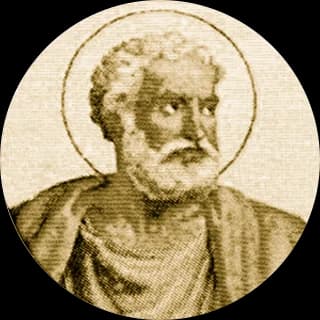
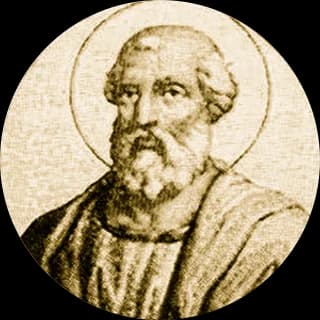
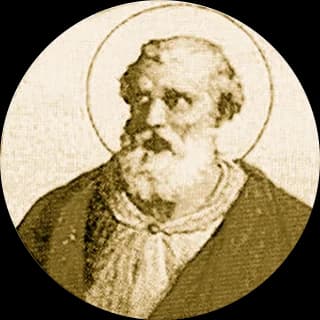
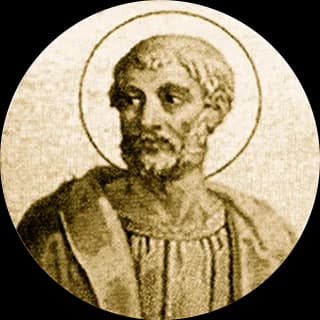
Popes No. 1-4
Nothing about the first four entries in this timeline looks like a papacy. There is no tiara, no court, no territory: only a small, illegal community in the imperial capital and the memory of a Galilean fisherman to whom, the community insisted, Jesus had given the keys. The evidence for these seventy years is thin and mostly later, which is why nearly every date here is marked traditional rather than documented. Yet the era set the two facts on which everything else in this timeline rests: that Peter died in Rome, and that the Roman church believed his role passed to successors. By the century's end a Roman letter to Corinth was telling another church how to behave, and that letter is where the history of the papacy, as opposed to its prehistory, can be said to begin.
The keys
The story starts with a question asked at Caesarea Philippi, in the foothills of Mount Hermon. Jesus asked his disciples who they said he was, and Simon the fisherman answered that he was the Messiah. Matthew's gospel, alone of the four, records the reply: a new name, Rock, a church built on it, and the keys of the kingdom of heaven. Whether the saying goes back to Jesus or reflects the standing Simon Peter had acquired in the decades after, it became the charter of the Roman claim, and it is carved in Latin around the base of Michelangelo's dome. Nothing in the text mentions Rome, bishops, or succession. That was the work of later centuries, and it is the reason the argument over these verses has never stopped.
Peter's career after the resurrection is better recorded than the rock saying and less exalted. The Acts of the Apostles shows him leading the Jerusalem community, preaching at Pentecost, facing the Sanhedrin, and baptizing the Roman centurion Cornelius without demanding circumcision, the first step toward a church that was not a Jewish sect. At the council of Jerusalem around 49 he spoke first for admitting Gentiles freely; James, the Lord's brother, gave the ruling. In Antioch, according to Paul, he lost his nerve on the same question and Paul "opposed him to his face." The apostle whom the church would later crown as its first monarch appears in the New Testament as a leader among equals, and not always the most consistent one.
Rome before the apostles
There were Christians in Rome before Peter or Paul set foot there. Suetonius records that the emperor Claudius expelled the Jews from the city around 49 for rioting "at the instigation of Chrestus," which is almost certainly a garbled account of quarrels over Jesus in the synagogues; Acts confirms the expulsion and names two of the exiles, Aquila and Priscilla, whom Paul met in Corinth. When Paul wrote to the Romans around 57 he greeted more than two dozen believers by name, in several house churches, and did not mention Peter. The community was Greek-speaking, largely immigrant, and scattered across the poorer districts beyond the Tiber and along the roads out of the city. It had no single bishop and no building.
Into that community, sometime in the early 60s, came Peter, and around the same time Paul under guard. Neither wrote an account of it. The First Epistle of Peter sends greetings from "Babylon," the code for Rome; Clement, a generation later, counted both apostles among the martyrs of his own time; Ignatius of Antioch, writing to the Roman church around 107, reminded them that Peter and Paul had commanded them and he could not. Nobody in antiquity ever claimed that Peter died anywhere else.
Nero's torches
On 18 July 64 a fire began by the Circus Maximus and burned for nine days. The rumor that Nero had set it never went away, and to answer it, Tacitus says, he fixed the blame on the Christians, "a class hated for their abominations," and killed them with a showman's ingenuity: sewn into animal skins for the dogs, nailed to crosses, burned as torches in his gardens across the river, beside the circus on the Vatican hill. Tacitus does not name the victims. The Christian tradition, from the late second century, put Peter's crucifixion in that circus, head downward at his own request, and Paul's beheading on the Ostian Way; around 200 a Roman presbyter named Gaius could offer to show a visitor "the trophies" of both apostles in those two places.
The trophy on the Vatican was real. Excavations under Saint Peter's between 1939 and 1949 found a pagan cemetery buried by Constantine's engineers, and in the middle of it a small shrine of about 160, two columns and a niche against a red-plastered wall, on which the whole basilica had been centered. Whether the bones later found in a cavity nearby are Peter's is disputed and probably unanswerable. What is not disputed is that a century after his death the Roman Christians knew, or believed they knew, where he lay, and that the basilica that Constantine built and Michelangelo crowned stands there because of it.
The names on the list
Who led the Roman church after the apostles is known from a list, not a narrative. Around 180 Irenaeus of Lyons, arguing against Gnostic teachers who claimed secret traditions, set out the public succession of the Roman bishops as proof that the apostolic teaching had been handed down openly: Linus, to whom the apostles "committed the office of the episcopate"; Anacletus; and "in the third place from the apostles" Clement, who "had seen the blessed apostles and conversed with them." The list is the oldest evidence for the second, third, and fourth popes, and it is nearly all the evidence there is. Linus is otherwise a name in Paul's Second Letter to Timothy; Anacletus is a Greek word meaning blameless, later split by confused scribes into two popes, Cletus and Anacletus, who kept separate feast days until 1960.
The Liber Pontificalis, compiled four centuries later, gave each of these men a homeland, a father, a reign measured in days, a decree or two, and a martyrdom. Most of it is invention filling a vacuum. What the early sources do preserve is the order of names, and the Roman church staked a great deal on that order. The Canon of the Mass still recites it: after Peter and Paul, "Linus, Cletus, Clement."
Clement writes to Corinth
Around 96 the church of Corinth threw out its presbyters, and a letter arrived from Rome. It was written in the name of the whole Roman community and does not name its author, but by the 170s Corinth, Rome, and Alexandria all agreed that Clement had written it. It is the first surviving Christian text outside the New Testament that can be dated with any confidence, and the first act of what the Roman church would come to regard as its office. Clement did not command. He argued, at enormous length, from the order of creation, the discipline of the Roman legions, the sins of Cain and Saul, and the recent deaths of Peter and Paul, that the apostles had appointed the first ministers and provided for their successors, and that dismissing blameless presbyters was a grave sin against that order. Then he sent three envoys to see that it was put right.
Corinth complied, kept the letter, and was still reading it at Sunday worship seventy years later. Whether that made Clement a pope in any sense he would have recognized is a question the letter cannot answer, since it never uses the word bishop of himself or of anyone in Rome. But it is the first time the church in the capital told another church what to do and was obeyed, and the argument it used, that authority passes from the apostles to appointed successors, is the argument every later pope would inherit. The legend of Clement's exile to the Crimea and death by drowning with an anchor came centuries later. The letter came first, and it is the point at which this timeline stops being a list of names and becomes a history.
The world at the time
- 30
religiousCrucifixion of Jesus
The event from which the entire Christian movement, and the office of Peter, flows; dated to 30 or 33 by most reckonings.
- 49
councilCouncil of Jerusalem
The apostles rule that Gentile converts need not keep the Mosaic law. Peter speaks first; James delivers the verdict.
- 49
politicalClaudius expels the Jews from Rome
Suetonius records disturbances 'at the instigation of Chrestus'; the Christians of Rome already exist, a decade before either apostle arrives.
- 64
politicalGreat Fire of Rome
Nero blames the Christians; tradition places the martyrdoms of Peter and Paul in the persecution that follows.
- 70
politicalDestruction of the Temple
Rome levels the Jerusalem Temple, and Christianity's center of gravity shifts decisively toward the imperial capital.
- 95
politicalDomitian turns on his household
The emperor executes his cousin the consul Flavius Clemens for 'atheism' and exiles Domitilla; Clement's letter opens amid 'sudden and repeated misfortunes.'