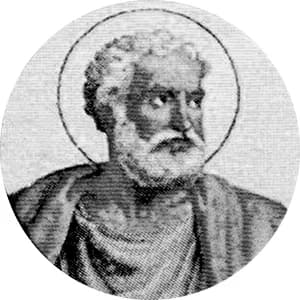
The Apostolic Age30-99
Saint Peter
The Galilean fisherman Jesus renamed the rock, crucified under Nero and buried, tradition holds, beneath the basilica that bears his name.
Pope no. 1c. 30-c. 64
Nothing about Simon of Bethsaida suggested a founder. He was a fisherman with a boat, a partner, a wife, and a mother-in-law, working the north shore of the Sea of Galilee when a preacher from Nazareth told him to leave the nets. The gospels remember him as impulsive, loyal, and wrong about as often as right: the first to call Jesus the Messiah and the first to be called Satan, the man who promised to die with him and denied him three times before morning. Yet the same gospels agree that Jesus gave him a new name, Rock, and Matthew adds a promise about keys that the church of Rome would spend two thousand years unfolding.
What can be said with confidence is less than the tradition claims and more than skeptics allow. Peter led the first community in Jerusalem, opened it to Gentiles, and argued with Paul in Antioch. He reached Rome in the last years of his life and died there in Nero's persecution, most likely in 64. Within a century the Roman Christians could point to his grave on the Vatican hill, and in 1968 a pope announced that bones found beneath the high altar were, as far as anyone could tell, his. No other entry in this timeline rests on so little documentation and carries so much weight.
The fisherman
John's gospel places his birth in Bethsaida, a fishing village where the Jordan enters the lake; by the time Jesus called him he lived in Capernaum, in a house that Mark says held his mother-in-law and that later pilgrims venerated under an octagonal church. His father was named Jonah or John. He fished in partnership with the sons of Zebedee and with his own brother Andrew, whom John's gospel credits with bringing him to Jesus in the first place. He spoke Aramaic with a Galilean accent that a servant girl in Jerusalem would later recognize.
The synoptic gospels tell the call simply: Jesus walked along the shore, saw the brothers casting a net, and said, "Follow me, and I will make you fish for people." Luke adds a miraculous catch and a reaction that reads like character: "Go away from me, Lord, for I am a sinful man." He did not go away. In every list of the Twelve his name comes first, and in the narratives he speaks for the group, asking the questions the others are thinking.
The rock and the keys
The decisive scene is set at Caesarea Philippi, in the far north of the country. Jesus asks the disciples who people say he is, and then who they say he is; Simon answers, "You are the Messiah, the Son of the living God." In Matthew's version alone, Jesus replies with the words carved in letters six feet high around the dome of the Vatican basilica: "You are Peter, and on this rock I will build my church, and the gates of Hades will not prevail against it. I will give you the keys of the kingdom of heaven." Six verses later, when Peter objects that the Messiah cannot be killed, Jesus calls him Satan and a stumbling block. Matthew intends both scenes to be read together.
What the saying meant to Matthew's first readers, and whether it implied successors, has been argued since the third century, and the argument is honest on both sides. Origen thought the rock was every believer who confessed as Peter did; Tertullian and Cyprian read it as Peter personally; the popes from Stephen I onward read it as their own office.
The rest of his story in the gospels is a portrait of a man who kept falling short and kept being called back. He swore he would die rather than deny his master, cut off a servant's ear in the garden, and before dawn denied him three times to strangers around a fire. The last chapter of John reverses the scene: three times on the lakeshore Jesus asks, "Simon son of John, do you love me?" and three times gives him the flock to feed, then tells him that when he is old someone else will fasten his belt and lead him where he does not want to go. The evangelist adds that this indicated the kind of death by which Peter would die.
Jerusalem and Antioch
The Acts of the Apostles opens with Peter in charge. He proposes the replacement of Judas, preaches the first sermon at Pentecost, heals a lame man at the Temple gate, and answers the Sanhedrin's ban on preaching with the sentence that would become the church's charter for civil disobedience: "We must obey God rather than any human authority." At Caesarea he baptizes the centurion Cornelius and his household without requiring circumcision, defending the decision in Jerusalem with the argument that God had given Gentiles the Spirit "just as he did to us." Around the year 44 Herod Agrippa I arrested him; Acts says an angel led him out of prison at night, that he left a message for James, and that "he went to another place." Luke never says where.
He was back for the council in Jerusalem around 49, when the question of whether Gentile converts must keep the Mosaic law came to a head. Peter spoke first and for freedom; James, the Lord's brother, delivered the verdict. That order tells its own story: Peter was the leading missionary, but the Jerusalem church now belonged to James.
The one glimpse of him from a contemporary's pen is not flattering. In his letter to the Galatians, Paul reports that at Antioch Peter had eaten freely with Gentile Christians until "certain people came from James," after which he withdrew, and that Paul "opposed him to his face, because he stood self-condemned." Paul does not say who won. Later tradition made Peter the first bishop of Antioch. Paul also mentions in passing that Peter traveled with his wife, and that a faction in Corinth claimed to belong to Cephas. After the mid-50s the record goes dark.
Rome
That Peter died in Rome is the best-attested fact of his later life, and it is attested by inference rather than narrative. The First Epistle of Peter, whether by him or by a disciple writing in his name, closes with greetings from "she who is in Babylon," the code that Jewish and Christian writers used for the imperial capital. Around 96 Clement of Rome named Peter and Paul at the head of the martyrs of "our own generation." A decade later Ignatius of Antioch told the Roman Christians, "I do not command you as Peter and Paul did." By the 180s Irenaeus could write of the church "founded and organized at Rome by the two most glorious apostles, Peter and Paul," and around 200 the Roman presbyter Gaius offered to show a visitor "the trophies of the apostles" on the Vatican hill and the Ostian Way. Nobody in antiquity claimed another city.
When he arrived and how long he stayed are another matter. Eusebius and Jerome give him twenty-five years as bishop of Rome, from the second year of Claudius, 42, to the last year of Nero, 67, and the figure entered the Liber Pontificalis and every medieval list.
The Roman church of those years was a scatter of Greek-speaking house congregations in the immigrant quarters across the Tiber, expelled with the Jews by Claudius in 49 and quietly returning under Nero. It had presbyters. It did not have a monarch: the word pope would not be applied to the bishop of Rome for centuries. What Peter brought was not a title but himself, the man who had been in the boat.
Nero's garden
On the night of 18 July 64 a fire began by the Circus Maximus and burned for nine days, destroying ten of the city's fourteen districts. Rumor blamed the emperor, and Tacitus records what Nero did about the rumor: he fastened the guilt on "a class hated for their abominations, called Christians by the populace," and had them torn by dogs, nailed to crosses, and burned as torches to light his gardens on the Vatican side of the river. Tacitus does not name Peter. The tradition offers two years, 64 and 67, for his death; the earlier fits the persecution, the later fits the twenty-five-year arithmetic.
Tertullian, around 200, says Peter "endured a passion like his Lord's," and Origen a generation later adds that he was crucified head downward at his own request. The apocryphal Acts of Peter, composed around 180, supply the rest of the legend: Peter fleeing the city along the Appian Way, meeting Christ walking toward it, asking "Lord, where are you going?" and hearing "To Rome, to be crucified again," then turning back. The same text puts the cross in Nero's circus beside the obelisk that still stands, moved a few hundred feet, in the center of Saint Peter's Square.
Peter, who because of unrighteous jealousy suffered not one or two but many trials, and having thus given his testimony went to the glorious place that was his due.
The Roman Christians buried him, or believed they had, in the necropolis along the north side of the circus, a poor man's grave among pagan mausoleums. Around 160 someone built a small shrine over it: two columns, a niche, a slab of travertine, set against a wall plastered red. That is the "trophy" Gaius pointed to. When Constantine built his basilica on the site in the 320s, his engineers cut into the hillside and buried the cemetery to make a level floor, and they centered the whole enormous building on that shrine.
The bones
The shrine was lost from sight for sixteen centuries under the altars of Gregory the Great, Callixtus II, and Clement VIII. In 1939 workmen lowering the floor of the grottoes for Pius XI's tomb broke through into the Roman cemetery, and Pius XII authorized a secret excavation that ran for ten years. It found the necropolis, the red wall, the trophy, and, in a pit beneath it, scattered bones that the pope announced at Christmas 1950 could not be identified. They turned out to belong to several people and a pig.
A second wall, built against the red wall around 250 and scratched with hundreds of Christian graffiti, held a marble-lined cavity that had been emptied during the dig without record. The epigrapher Margherita Guarducci read one fragment as "Peter is within," traced the cavity's contents to a storeroom, and had them examined: the bones of a single robust man in his sixties, wrapped in purple and gold cloth, the feet missing. On 26 June 1968 Paul VI told a general audience that the relics of Saint Peter "have been identified in a way that we can consider convincing."
The question, in the end, is smaller than it looks. Whatever lies under the altar, the Roman Christians of the second century believed that Peter had died among them and had his grave among them, and on that belief they built a claim no other church could match: that their bishop sat where Peter had sat. Every pope in this timeline is, in the church's reckoning, that fisherman's successor. He would not have understood the word. But the chair is named for him, and the argument about what he was given at Caesarea Philippi has never stopped.
Sources
- J. N. D. Kelly and Michael Walsh, The Oxford Dictionary of Popes (2010)
- Eamon Duffy, Saints and Sinners: A History of the Popes (2014)
- Oscar Cullmann, Peter: Disciple, Apostle, Martyr (1962)
- John Evangelist Walsh, The Bones of St. Peter (1982)
- Markus Bockmuehl, Simon Peter in Scripture and Memory (2012)
- Eusebius of Caesarea, The Ecclesiastical History (325) · link
- Further reading: Wikipedia