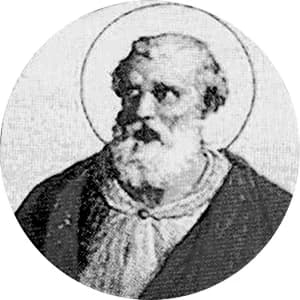
The Apostolic Age30-99
Saint Anacletus
One man with two names, counted for a thousand years as two popes: the third bishop of Rome, who reigned through Domitian's early years.
Pope no. 3c. 79-c. 92
The third name on Irenaeus's list is Anencletus, a Greek word meaning blameless, and the Greek form is the first clue to what the Roman church still was in the 80s: an immigrant community that prayed, argued, and wrote in the language of the eastern Mediterranean. Eusebius, following Irenaeus, gives him twelve years. Beyond the name and the number the early sources are silent.
The later ones were not, and their confusion is the most interesting thing about him. The name circulated as Anacletus and as the shortened Cletus, and by the fourth century Roman chroniclers took them for two men. The Liberian Catalogue of 354 lists both; the Liber Pontificalis gives each a biography, making Cletus a Roman, son of Aemilianus, who ordained twenty-five presbyters for the city, and Anacletus an Athenian, son of Antiochus, who "built and set in order a memorial to the blessed Peter" and buried other bishops beside him. On the strength of those entries the medieval church kept two feasts, 26 April for Cletus and 13 July for Anacletus, and numbered its popes accordingly for a thousand years.
The memorial is worth a pause. Excavations under Saint Peter's in the 1940s found a small shrine over the grave the Romans honored as Peter's, but it dates from around 160, two generations later, and nothing ties Anacletus to the site. His reign coincided with the accession of Domitian in 81 and ended, if the traditional date holds, a few years before that emperor's turn against his own household exposed Rome's Christians to a second persecution. What Anacletus did about any of it, no one wrote down.
A full essay on this pope is in preparation. The facts and summary above are complete and sourced.