The Apostolic Age30-99
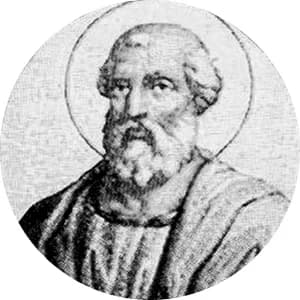
Saint Linus
The first successor: a name in Paul's last letter, a line in Irenaeus, and almost nothing else that history can confirm.
Pope no. 2c. 67-c. 79
Everything solid that is known about Linus fits in two sentences. Around the year 180 Irenaeus of Lyons, tracing the bishops of Rome back to the apostles, wrote that Peter and Paul, "having founded and built up the church, committed into the hands of Linus the office of the episcopate," and identified him with the Linus who sends greetings at the end of Paul's Second Letter to Timothy. Every later list follows Irenaeus in placing him second.
The rest is embroidery of varying ages. The Liber Pontificalis, compiled in the sixth century, makes him an Italian from Tuscany, the son of one Herculanus, and gives his reign as eleven years, three months, and twelve days; the Tuscan town of Volterra claims him. The same source credits him with a decree that women must cover their heads in church, a rule lifted from Paul's First Letter to the Corinthians and projected backward onto the first available pope. It also says he died a martyr and was buried beside Peter on the Vatican hill.
Even his place in the order was once contested: Tertullian, writing around 200, said Peter himself had ordained Clement. What Linus actually did between the death of the apostles and his own is unrecorded, and he probably presided over a council of presbyters rather than ruling as a bishop in the later sense. He remains in the Roman Canon of the Mass, named immediately after Peter and Paul at every altar in the Latin church, which is more than most of his better-documented successors can say.
A full essay on this pope is in preparation. The facts and summary above are complete and sourced.