The Imperial Church311-483
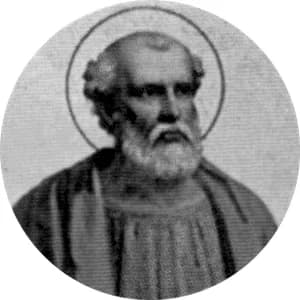
Saint Zosimus
Twenty-one months of misjudgment: he acquitted Pelagius's disciple, reversed under African pressure, and quoted canons Nicaea never passed.
Pope no. 41417-418
Zosimus was a Greek, the son of a man named Abram according to the Liber Pontificalis, and he took office on 18 March 417 with the confidence of a man who had not read the file. Innocent had condemned Pelagius and his disciple Caelestius two months earlier. Caelestius came to Rome with a confession of faith; Zosimus examined him in the basilica of Saint Clement, found him orthodox, received a similar profession from Pelagius, and wrote to the African bishops in September rebuking them for judging hastily.
The Africans did not appeal; they legislated. A council of more than two hundred bishops at Carthage on 1 May 418 restated the condemnation in nine canons, and the day before it met the emperor Honorius, whom they had lobbied, issued a rescript banishing Pelagians from Rome. Zosimus, finding the Roman clergy, the court, and Augustine all against him, issued the Tractoria, a circular letter condemning Pelagius and Caelestius and requiring every bishop to sign. Eighteen Italian bishops refused, among them Julian of Eclanum, and were deposed.
His second miscalculation concerned Africa too. When a priest named Apiarius, excommunicated by his bishop at Sicca, appealed to Rome, Zosimus sent legates to Carthage with the canons that entitled Rome to hear such appeals, describing them as Nicene. They were the canons of the Western council of Sardica of 343. The Africans, who had Greek copies of Nicaea, sent to Alexandria and Constantinople for authentic texts and wrote back, with great courtesy, that the canons were not there.
A full essay on this pope is in preparation. The facts and summary above are complete and sourced.
Sources
- J. N. D. Kelly and Michael Walsh, The Oxford Dictionary of Popes (2010)
- Eamon Duffy, Saints and Sinners: A History of the Popes (2014)
- Raymond Davis (trans.), The Book of Pontiffs (Liber Pontificalis) (2000)
- Further reading: Wikipedia