The Imperial Church311-483
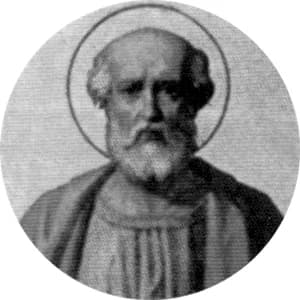
Saint Innocent I
A pope's son who ruled the West by letter, broke with the East over Chrysostom, missed Alaric's sack, and closed the case against Pelagius.
Pope no. 40401-417
Innocent governed the Roman church for fifteen years as if the whole Latin West were its diocese, and much of the West agreed. He was the son of his predecessor Anastasius, if Jerome is believed, and he inherited a chancery that had learned under Damasus and Siricius to answer questions from the provinces in the form of imperial rescripts. He used it on a scale no pope had attempted: rulings for Rouen, Toulouse, and Gubbio on the calendar, the sacraments, and the canon of scripture; a vicariate over the Balkans; the first papal list of the books of the Bible; and, in the last months of his life, the letters that confirmed the condemnation of Pelagius and let Augustine tell his congregation that the case was closed.
He also saw the two great shocks of the age from an unusual angle. When Alaric's Goths sacked Rome in August 410, the first time an enemy had taken the city in eight centuries, Innocent was in Ravenna trying to negotiate with the emperor, and the historians of his own party compared him to Lot led out of Sodom. And when the archbishop of Constantinople was deposed and exiled by his enemies, Innocent refused to recognize it, broke communion with the three great sees of the East, and did not restore it until the exile was dead and his name back on their altars. It was the first time Rome had stood alone against the East on a question of persons rather than doctrine, and it won.
The son of a pope
Innocent was born at Albano, according to the Liber Pontificalis, and was elected on 22 December 401, three days after Anastasius died, without a recorded rival. Jerome, who knew the family, called the succession that of a son to a father and saw nothing in it to remark on. The new pope was a Roman of the senatorial world, a friend of the great Christian families, and a lawyer's mind: his letters are short, exact, and impatient with people who have not read the previous correspondence.
The decretals began at once. To Victricius of Rouen in 404 he sent a set of rules on the ordination and continence of clergy, the reception of Novatianists, and appeals from provincial synods to Rome. To Exuperius of Toulouse in 405 he added the first papal list of the canon of scripture, including the books the Reformers would later call apocrypha. To Decentius of Gubbio in March 416 he laid down the Roman liturgy as the standard, since "all the churches of Italy, Gaul, Spain, Africa, Sicily, and the islands were founded by Peter or his successors," and no one could claim another apostle as their source. The same letter reserved confirmation to bishops, described the fermentum that Rome sent to its parishes, and explained the anointing of the sick in terms the Council of Trent would quote eleven centuries later.
Chrysostom
In 403 a synod outside Constantinople, organized by Theophilus of Alexandria, deposed the archbishop John Chrysostom on charges that everyone understood to be political, and in 404 the emperor Arcadius sent him into exile in Armenia. John appealed to Rome, to Milan, and to Aquileia. Innocent wrote back that he recognized no deposition, that a proper council should rehear the case, and that he remained in communion with John; he wrote to John's clergy and people in the same terms, and persuaded Honorius to write to his brother asking for a council. The envoys who carried the letters were arrested at the Hellespont, robbed, and sent home.
Innocent then did what no pope had done. He broke communion with Theophilus of Alexandria, with Atticus of Constantinople, and with Porphyry of Antioch, the three men who had accepted John's removal, and held the breach for years. John died in exile in 407. His name was restored to the diptychs of Constantinople in 412 and of Antioch and Alexandria by 417, and only then did Rome restore communion. The patriarchates had bent to a pope's judgment on one of their own.
Alaric
The Gothic army first stood before Rome in the autumn of 408, and the pagan historian Zosimus tells a story that has followed Innocent since: that the prefect proposed appeasing the old gods with public sacrifices on the Capitol, and that the pope, "putting the safety of the city above his own opinion," consented in private provided the rites were secret. Nothing came of it, Zosimus says, because the senators would not perform them in public.
The city bought Alaric off that winter. In 409 Innocent went to Ravenna with a senatorial embassy to persuade Honorius to make terms, and was still there when the negotiations collapsed and the Goths came back. On 24 August 410 they entered by the Salarian Gate and held Rome for three days. They respected the churches of Peter and Paul as sanctuaries, carried off the sister of the emperor, and left a city that had not been taken since the Gauls in 390 BC. Orosius, writing a few years later, said that God had removed the bishop as he had removed Lot, so that the just man should not see the destruction of the sinners. Innocent came home to a Rome half-empty and spent the rest of his reign restoring it.
Pelagius
The British monk Pelagius had taught in Rome for years, respected and orthodox as far as anyone could tell, until he fled Alaric to Africa and Palestine and Augustine read what he had written. The quarrel over grace and free will, whether a human being could take the first step toward God unaided, was fought out in Africa, and in 416 two councils, at Carthage and at Milevis, condemned Pelagius and his disciple Caelestius and wrote to Rome for confirmation. Five bishops, Augustine among them, sent a private letter as well, enclosing Pelagius's book with the offending passages marked.
Innocent replied on 27 January 417 in three letters. He confirmed the condemnation, excluded both men from communion until they recanted, and praised the Africans for consulting "the apostolic see" as the source from which all the churches drew their water, observing that they had kept the ancient rule that nothing done in the provinces should be concluded until it had come to Rome's knowledge. He died six weeks later. In Carthage, on 23 September, Augustine told his congregation what the letters meant.
Already two councils have sent to the apostolic see about this matter, and from there rescripts have come. The case is finished; would that the error were finished too.
What stuck
Innocent died on 12 March 417 and was buried above his father in the cemetery of Pontian on the road to the port. He had not invented the decretal, but he had made it the normal way for Rome to speak to the West, and the Western churches had learned to ask. The principle he stated to Decentius, that the churches of the West were Peter's foundations and should keep Peter's customs, would be the basis on which Leo, Gregory, and the medieval popes governed; the break with the East over Chrysostom was the first of a long series in which Rome's standing rested on refusing to accept what a patriarch had done. He is a saint of the Roman calendar on the day of his death, and the pope whom, more than any other, the West of the fifth century simply obeyed.
Sources
- J. N. D. Kelly and Michael Walsh, The Oxford Dictionary of Popes (2010)
- Eamon Duffy, Saints and Sinners: A History of the Popes (2014)
- Catholic Encyclopedia, Pope St. Innocent I (1910) · link
- Augustine of Hippo, Sermons (417)
- Zosimus, New History (Historia Nova), Book V (500)
- Raymond Davis (trans.), The Book of Pontiffs (Liber Pontificalis) (2000)
- Further reading: Wikipedia