The Age of Persecution99-311
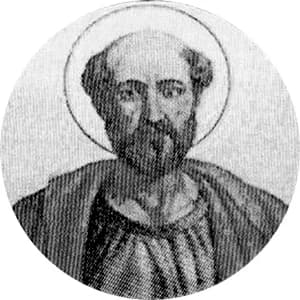
Saint Telesphorus
The one second-century pope whose martyrdom is vouched for by a witness who could have known: Irenaeus called his death glorious.
Pope no. 8c. 125-c. 136
Among the shadowy bishops between Clement and Pius, Telesphorus stands out for one reason: someone who might have known said he was killed. Irenaeus, listing the Roman succession around 180, wrote that Telesphorus "was gloriously martyred," and Irenaeus said it of no other early bishop. Eusebius, following him, dated the death to the first year of Antoninus Pius after eleven years in office, which the Annuario Pontificio rounds to 136, still under Hadrian.
How and why he died is unrecorded. Hadrian's policy was Trajan's: no hunting of Christians, but death for any who were denounced and refused to sacrifice. A bishop was an obvious target if a neighbor or a rival chose to denounce him, and the death of Telesphorus is probably best understood as one such prosecution rather than a persecution. The Liber Pontificalis calls him a Greek and a former hermit, which a later tradition located in Calabria and the Carmelites, who claim him as a patron, took as a sign of the contemplative life.
He was buried, the Liber Pontificalis says, beside Peter on the Vatican. His feast falls on 5 January in the West and 22 February among the Greeks, who kept the memory of a Greek bishop of Rome longer than Rome did.
A full essay on this pope is in preparation. The facts and summary above are complete and sourced.