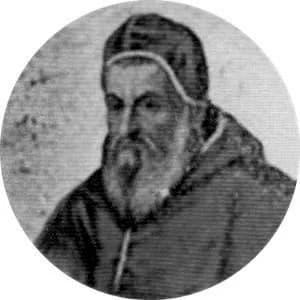
Reformation and Counter-Reformation1513-1605
Sixtus V
Five volcanic years: he broke the bandits, rebuilt Rome around its pilgrim roads, raised the obelisk, and finished the dome.
Pope no. 2271585-1590
Felice Peretti herded pigs as a boy in the March of Ancona, entered the Franciscans at twelve, and rose on the twin engines the Counter-Reformation rewarded: preaching and inquisition. As Pope Sixtus V he compressed into five years what unhurried pontificates spread across twenty: he restored order to a bandit-ridden state with pitiless efficiency, replanned Rome so completely that the modern city still moves along his avenues, raised the Vatican obelisk, finished Michelangelo's dome, capped the college of cardinals at seventy, and reorganized the curia into the fifteen congregations that governed Catholicism until the twentieth century. Romans hated him, feared him, and never stopped talking about him. Institutionally, he is the most consequential five-year pope in the office's history.
The friar who waited
Peretti's rise was talent plus patience plus one lucky enmity. A celebrated Lenten preacher in Rome by his thirties, he attached himself to the reform party of Paul IV and Pius V, served as inquisitor in Venice (so harshly the Republic asked for his recall), helped prosecute the heresy case against Archbishop Carranza of Toledo, and got his cardinal's hat from Pius V in 1570. Under Gregory XIII, whom he detested and who returned the sentiment, he spent thirteen years in studied retirement, editing the works of St. Ambrose, building his villa, and watching. The conclave legend, embroidered by later writers, has him entering on crutches and flinging them away at the moment of election; the documented reality is duller and more impressive: at sixty-three he was elected quickly, as a vigorous compromise everyone underestimated, on 24 April 1585.
Rome learned its mistake within weeks. Four bandits were hanging by his coronation day, and the message was general.
Order, by the rope
Gregory XIII had left the Papal States in something close to anarchy: thousands of banditti, many under noble protection, controlled the roads. Sixtus made their destruction his first and most theatrical policy. Bounties were paid for bandits dead or alive, protecting nobles were fined or executed alongside their clients, borders were coordinated with neighboring states so fugitives found no refuge, and the heads of the taken were displayed on the bridge of Castel Sant'Angelo until, contemporaries joked grimly, they outnumbered the melons in the market. Modern estimates of executions run into the thousands, and the methods would satisfy no modern jurist. The result, within two years, was the safest roads Italy had known in a generation, a treasury able to collect its own taxes, and a reputation for implacability that did half his governing for him afterward.
The same ferocity ran his finances. By taxes, loans against secured revenues, the sale of offices, and a miser's control of spending, he piled up one of Europe's great treasuries, some four and a half million scudi locked in Castel Sant'Angelo as a reserve. Economists have scolded him for freezing capital ever since; his successors, who spent it, were duly grateful.
The city as a sermon
Sixtus V's Rome is the reason urban historians know his name. With his engineer Domenico Fontana he drove straight avenues across the medieval tangle to link the seven pilgrimage basilicas, so that the holy year crowds could move: the Strada Felice running from Santa Maria Maggiore toward Trinità dei Monti, the axes radiating from the obelisks he planted as landmarks. He repaired the ancient aqueduct he renamed Acqua Felice after himself, bringing the first new water to Rome's high ground since antiquity and making the hills habitable again; fountains followed, and laundries, and neighborhoods.
The obelisk was the showpiece. The Vatican obelisk, standing since Caligula beside St. Peter's, had defeated every engineer who proposed moving it. Fontana shifted the 330-ton monolith to the center of the piazza in 1586 with towers, capstans, nine hundred men, and a famous decree of silence on pain of death; the legend of the sailor crying "water on the ropes" at the critical moment is just that, a legend, but the raising itself was the engineering feat of the century, repeated at three more basilicas. And on the skyline, the work that outranks them all: Sixtus put crews on Michelangelo's unfinished dome around the clock, and the great vault of St. Peter's closed in 1590, months before his death. He also, with characteristic subtlety, demolished the Septizodium for building stone and mounted saints Peter and Paul atop the columns of Trajan and Marcus Aurelius: antiquity conscripted into the Counter-Reformation.
The machinery
The least visible reform was the most durable. The constitution Postquam verus of 1586 fixed the college of cardinals at seventy, a ceiling that held until 1958; Immensa aeterni Dei in 1588 organized the curia into fifteen standing congregations with defined portfolios (the Inquisition, the Index, rites, bishops, universities, roads and waters), converting the papacy's medieval court into a cabinet government. Popes came and went; the congregations processed. It was the administrative constitution of Catholicism for over three centuries, until the twentieth century's reorganizations, and pieces of its logic survive in today's dicasteries. His one great botch was philological: impatient with his scholars, he personally edited the official Vulgate Bible and rushed it to print in 1590 so error-ridden that his successors quietly bought back copies and reissued a corrected edition under a face-saving pretext. Infallibility, the episode reminded everyone, does not extend to proofreading.
The reckoning
Sixtus died of malaria on 27 August 1590, and Rome celebrated exactly as it had for Paul IV: the mob pulled down his statue on the Capitol, and the city that used his roads, drank his water, and prayed under his dome cursed his taxes and his gallows in the same breath. The Spanish ambassador had spent the pope's last year in shouting matches over Sixtus's visible reluctance to bankroll Spain's Armada against England, a skepticism events vindicated. Posterity's ledger is less conflicted than Rome's was. The bandit terror and the frozen treasure were the era's brutal, expedient politics; the avenues, the aqueduct, the dome, the seventy cardinals, and the congregational curia were permanent. Most popes govern the church they inherit. Sixtus V, in five years, built the one his successors inherited, and they ran it, substantially unchanged, until living memory.
Sources
- J. N. D. Kelly and Michael Walsh, The Oxford Dictionary of Popes (2010)
- Eamon Duffy, Saints and Sinners: A History of the Popes (2014)
- Ludwig von Pastor, The History of the Popes from the Close of the Middle Ages, vols. 21-22 (1932)
- Sigfried Giedion (in Space, Time and Architecture), Rome of Sixtus V: The Planning of a Baroque City (1941)
- Further reading: Wikipedia