The Byzantine Papacy483-752
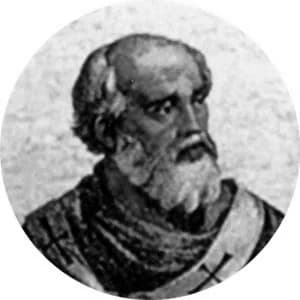
Sisinnius
Twenty days in the chair, too crippled by gout to lift his hand to his mouth, and still ordering lime burned to repair the walls of Rome.
Pope no. 87708
Sisinnius was a Syrian, the son of a man named John, and he was consecrated on 15 January 708 after a vacancy of three months. He was so afflicted with gout, the Liber Pontificalis says, that he could not raise his hands to his mouth to eat, and he died on 4 February, twenty days later. The compilers, who had to write something, recorded that he was "of firm character and careful of the citizens of this city," and one act that proves it: he ordered lime burned for the repair of the walls of Rome.
The walls needed it. The Aurelian circuit, built in the 270s and last restored under Belisarius, had gaps that the Lombards knew about, and the Arabs, who had taken Carthage in 698 and were raiding Sicily and Sardinia, had begun to be a Mediterranean threat rather than an Eastern one. A pope who spent his three weeks on lime kilns had understood what the eighth century would demand of the papacy: not doctrine, which the council of 681 had settled, but walls, food, and the defense of a city the empire no longer defended. Gregory II would repair the walls in earnest, and Gregory III and Zachary would build the towers.
His is the shortest pontificate between the seventh century and the eleventh, and one of the few for which the sole recorded act is entirely practical.
A full essay on this pope is in preparation. The facts and summary above are complete and sourced.
Sources
- J. N. D. Kelly and Michael Walsh, The Oxford Dictionary of Popes (2010)
- Andrew J. Ekonomou, Byzantine Rome and the Greek Popes (2007)
- Raymond Davis (trans.), The Book of Pontiffs (Liber Pontificalis) (2000)
- Further reading: Wikipedia