The Byzantine Papacy483-752
John VII
An official's son who moved the papacy to the Palatine, put his portrait in two churches, and sent the emperor's canons back unsigned.
Pope no. 86705-707
John's father, Plato, had been the imperial curator of the Palatine, the official responsible for what was left of the emperors' palaces, and his epitaph survives in the church of Santa Maria Antiqua at the hill's foot. The son, Greek by descent and rector of the papal estates on the Appian Way, was consecrated on 1 March 705 and governed from his father's ground: he built a papal residence on the Palatine above Santa Maria Antiqua, the first time a pope had lived away from the Lateran, and he had the church below it painted with frescoes in which he appears, square-haloed as a living man, holding the building.
He was a patron of art before anything else. In Saint Peter's he built an oratory of the Virgin and covered it in mosaic, with his own portrait presenting the chapel and the inscription "John, the servant of holy Mary"; fragments, including the Madonna, survived the basilica's demolition and are scattered from the Vatican grottoes to Florence. The Liber Pontificalis, which admired the work, was less impressed by the man.
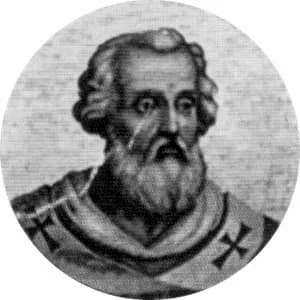
He died on 18 October 707 and was buried in his oratory in Saint Peter's. The face in the mosaic and in the fresco below the Palatine is the earliest surviving lifetime portrait of a pope that is still recognizably a portrait.
A full essay on this pope is in preparation. The facts and summary above are complete and sourced.
Sources
- J. N. D. Kelly and Michael Walsh, The Oxford Dictionary of Popes (2010)
- Andrew J. Ekonomou, Byzantine Rome and the Greek Popes (2007)
- Raymond Davis (trans.), The Book of Pontiffs (Liber Pontificalis) (2000)
- Further reading: Wikipedia