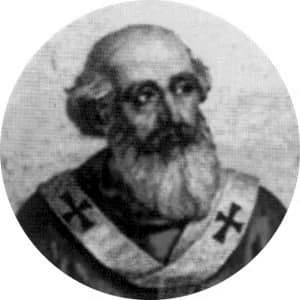
The Carolingian Papacy752-903
Sergius II
A gouty aristocrat whose brother sold bishoprics while the Saracens landed at Ostia and stripped the tomb of Saint Peter.
Pope no. 102844-847
Sergius came from the Roman nobility, the family that had already given the church Stephen IV, and he was an old man lame with gout when Gregory IV died in January 844. The nobles elected him; a crowd elected the deacon John and put him in the Lateran; Sergius's party threw John out, and Sergius, who stopped his followers from killing him, was consecrated at once without a word to the emperor Lothair. Lothair took the omission as defiance. He sent his son Louis south with an army and Archbishop Drogo of Metz, and the Franks ravaged the countryside on the way. Sergius received Louis on the steps of Saint Peter's but kept the doors shut until the young king had sworn he came in peace, and a synod in the basilica in June 844 restored the balance: Sergius crowned Louis king of the Lombards, the Romans swore fealty to Lothair, and it was agreed that no pope would in future be consecrated without imperial consent and imperial envoys present.
Sergius then let his brother Benedict, whom he had made bishop of Albano, run the government. Benedict sold bishoprics and offices, the Liber Pontificalis says, to anyone with the price, and Rome remembered it when the punishment came. In August 846 a Saracen fleet landed at Ostia and marched on the city. The walls held, but Saint Peter's and Saint Paul's, both outside them, were stripped: the silver of the altar, the gold of the confessio, the bronze doors, the plate of three centuries.
Sergius died on 27 January 847, before the walls that would answer the raid were begun.
A full essay on this pope is in preparation. The facts and summary above are complete and sourced.
Sources
- J. N. D. Kelly and Michael Walsh, The Oxford Dictionary of Popes (2010)
- Eamon Duffy, Saints and Sinners: A History of the Popes (2014)
- Raymond Davis (trans.), The Lives of the Ninth-Century Popes (Liber Pontificalis) (1995)
- Peter Llewellyn, Rome in the Dark Ages (1971)
- Further reading: Wikipedia