The Carolingian Papacy752-903
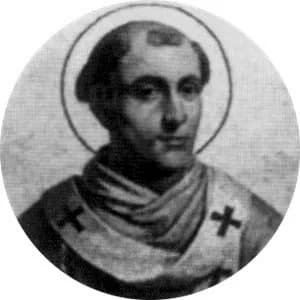
Saint Leo IV
He walled the Vatican after the Saracen sack, blessed the fleet that beat them at Ostia, and gave the Leonine City its name.
Pope no. 103847-855
Leo was a Roman of Lombard descent, son of Radoald; a monk at San Martino beside Saint Peter's, then subdeacon under Gregory IV and cardinal priest of Santi Quattro Coronati. He was elected the day Sergius died and consecrated on 10 April 847 without waiting for the emperor, and this time no one complained: the Saracens had sacked Saint Peter's eight months before and the Romans wanted a pope. He gave them a wall. From 848 to 852, with imperial money and labor levied from the papal farms and towns, he enclosed the Vatican hill, the basilica, and the Borgo in a circuit forty feet high with forty-four towers, and on 27 June 852 he walked it barefoot with the clergy, blessing each gate. It was the first extension of Rome's defenses since Aurelian, and the quarter it made is still the Leonine City.
He also fought. In 849 a Saracen fleet gathered off Sardinia, and Leo brought together the ships of Naples, Gaeta, and Amalfi under Caesarius of Naples, blessed them at Ostia, and watched a storm finish what the battle began; the prisoners were set to work on the walls. He refounded Porto with Corsican refugees and rebuilt Centumcellae, ruined by the raiders, as Leopolis. At a synod in December 853 he issued forty-two canons on clerical discipline and deposed and excommunicated Anastasius, cardinal priest of San Marcello, who had deserted his church for five years and lived under Frankish protection; Anastasius would be back.
Leo died on 17 July 855 and is a saint of the Roman calendar on that day.
A full essay on this pope is in preparation. The facts and summary above are complete and sourced.
Sources
- J. N. D. Kelly and Michael Walsh, The Oxford Dictionary of Popes (2010)
- Eamon Duffy, Saints and Sinners: A History of the Popes (2014)
- Raymond Davis (trans.), The Lives of the Ninth-Century Popes (Liber Pontificalis) (1995)
- Peter Llewellyn, Rome in the Dark Ages (1971)
- Further reading: Wikipedia