The Carolingian Papacy752-903
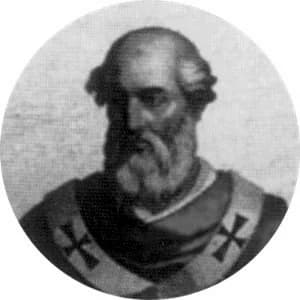
Gregory IV
Consecrated only when the emperor's men approved, he crossed the Alps to make peace between Louis the Pious and his sons, and was used.
Pope no. 101827-844
Gregory was a Roman noble, son of John, and cardinal priest of San Marco, which he rebuilt and whose apse mosaic still shows him with the square halo. He was elected soon after Valentine's death in the autumn of 827, but he was not consecrated until 29 March 828, when the emperor's envoys had examined the election under the terms of the Constitutio Romana. He was the first pope to wait for that approval, and the delay set the tone of a reign Frankish politics kept overshadowing.
In 833 the sons of Louis the Pious rose against their father, and Lothair brought Gregory across the Alps to mediate. The bishops loyal to Louis warned him that if he came to excommunicate he would go home excommunicated; Gregory's answer, drafted for him by Wala and Paschasius Radbertus, argued that the government of souls, which is the pope's, outranks the government of the empire. At the meeting place in Alsace, remembered as the Field of Lies, Louis's army deserted to his sons while the pope was in their camp, and the emperor was deposed. Gregory went home having served, in the eyes of most Franks, as Lothair's decoy.
Nearer home the danger was Muslim: the Aghlabids of Tunisia took Palermo in 831, and their ships were soon off the Italian coast. Gregory rebuilt Ostia as a walled town with a garrison, Gregoriopolis, to guard the Tiber mouth. He also gave Ansgar, the apostle of the North, the pallium and a legation for Hamburg in 832. He died on 25 January 844, having outlived Louis and seen the empire divided at Verdun.
A full essay on this pope is in preparation. The facts and summary above are complete and sourced.
Sources
- J. N. D. Kelly and Michael Walsh, The Oxford Dictionary of Popes (2010)
- Eamon Duffy, Saints and Sinners: A History of the Popes (2014)
- Raymond Davis (trans.), The Lives of the Ninth-Century Popes (Liber Pontificalis) (1995)
- Peter Llewellyn, Rome in the Dark Ages (1971)
- Further reading: Wikipedia