The Age of Revolution1799-1958
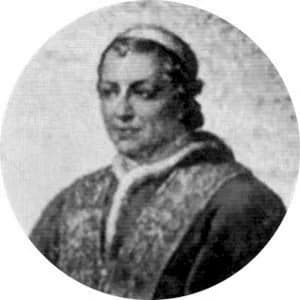
Pius IX
Elected as a liberal hope in 1846, he lost Rome, defined papal infallibility, and reigned longer than any pope whose dates can be verified.
Pope no. 2551846-1878
Giovanni Maria Mastai-Ferretti, a warm, impulsive bishop of Imola with a reputation for liberal sympathies, was elected on 16 June 1846 in two days. He amnestied political prisoners, installed gas lamps and railways his predecessor had banned, and in March 1848 granted the Papal States a constitution. Then the revolution he had seemed to bless turned on him. He refused to lead a war against Catholic Austria, his prime minister Pellegrino Rossi was stabbed to death on the steps of the parliament in November 1848, and on the twenty-fourth the pope slipped out of Rome disguised as a simple priest and fled to Gaeta. Mazzini's Roman Republic lasted five months before French troops restored him, and the man who returned in April 1850 had concluded that liberalism and the church could not coexist.
The second, longer Pius IX built the modern papacy's spiritual authority as its temporal power drained away. He defined the Immaculate Conception of Mary on 8 December 1854, the first dogma proclaimed by a pope on his own authority; in 1864 the Syllabus of Errors condemned eighty propositions of the age; and in 1869 he opened the First Vatican Council, which on 18 July 1870 defined papal infallibility. Two months later, on 20 September 1870, Italian troops breached the Porta Pia and Rome became the capital of a united Italy. The pope refused the Law of Guarantees, forbade Catholics to vote in Italian elections, and never left the Vatican again, styling himself its prisoner. The 1858 seizure of a baptized Jewish child, Edgardo Mortara, whom he raised as his own, remains the reign's most notorious act.
He died on 7 February 1878 after thirty-one years and seven months, the longest verified pontificate in history; when his body was moved across Rome in 1881, an anticlerical mob tried to throw it into the Tiber. John Paul II beatified him in 2000.
A full essay on this pope is in preparation. The facts and summary above are complete and sourced.
Sources
- J. N. D. Kelly and Michael Walsh, The Oxford Dictionary of Popes (2010)
- Eamon Duffy, Saints and Sinners: A History of the Popes (2014)
- Owen Chadwick, A History of the Popes, 1830-1914 (1998)
- David I. Kertzer, The Pope Who Would Be King: The Exile of Pius IX and the Emergence of Modern Europe (2018)
- Further reading: Wikipedia