The Age of Revolution1799-1958
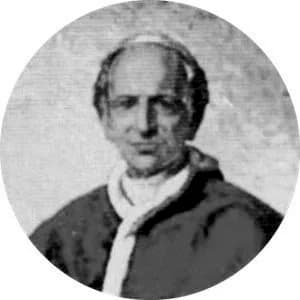
Leo XIII
The sixty-seven-year-old 'transitional' pope who reigned a quarter century and wrote the charter of Catholic social teaching.
Pope no. 2561878-1903
Gioacchino Pecci had spent thirty-two years as bishop of Perugia, kept out of Rome by a secretary of state who distrusted him, when the cardinals elected him on the third ballot on 20 February 1878. He was sixty-seven, thin, and thought to be frail; the conclave wanted a pause after Pius IX's thirty-two years. It got twenty-five more, and a pope who, without surrendering a single one of his predecessor's claims, changed the papacy's posture from siege to engagement. He still refused to recognize the Italian state, still forbade Catholics to vote, still called himself a prisoner. But he opened the Vatican archives to scholars of every confession in 1881, refounded the Vatican Observatory, made peace with Bismarck's Germany after the Kulturkampf, urged French Catholics to accept their republic, and became, at the end of his life, the first pope to be filmed and the first whose voice was recorded.
He governed by encyclical, eighty-six of them. Aeterni Patris (1879) restored Thomas Aquinas to the center of Catholic thought and set the intellectual agenda for the next eighty years; Immortale Dei (1885) and Libertas (1888) worked out how a church that rejected liberalism in theory could live under liberal states in practice; Providentissimus Deus (1893) cautiously admitted the church to modern biblical scholarship. The one that made him immortal came on 15 May 1891. Rerum novarum, addressed to the condition of the working classes, defended private property against socialism and the worker against unregulated capitalism in the same breath, affirmed the right to a just wage and to form unions, and made the state responsible for protecting the poor. Every subsequent pope has written in its shadow; Leo XIV took his name from it.
Leo XIII died on 20 July 1903 at ninety-three, the oldest pope in history and, by his own measure, still a prisoner in his palace. He had made the prison a pulpit heard around the world.
A full essay on this pope is in preparation. The facts and summary above are complete and sourced.
Sources
- J. N. D. Kelly and Michael Walsh, The Oxford Dictionary of Popes (2010)
- Eamon Duffy, Saints and Sinners: A History of the Popes (2014)
- Owen Chadwick, A History of the Popes, 1830-1914 (1998)
- Further reading: Wikipedia