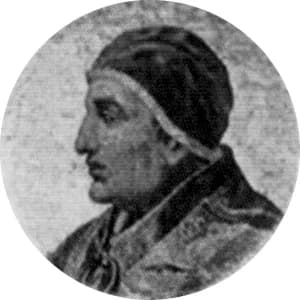
The Renaissance Papacy1447-1513
Pius III
Twenty-six days: the gouty, upright nephew of Pius II, ordained priest eight days after his election and dead ten days after his coronation.
Pope no. 2151503
Francesco Todeschini was the son of Pius II's sister, and the pope adopted him into the Piccolomini name, made him archbishop of Siena at twenty-one, and gave him a cardinal's hat in the same year, 1460. He then did something unusual for a Renaissance cardinal-nephew: he earned the hat. Over forty-three years in the college he served as legate in Germany and Umbria, kept clear of the Borgia court's bargains, refused to attend the consistories that ratified Cesare's conquests, and in 1502 commissioned Pinturicchio to fresco the library he built in Siena's cathedral in his uncle's memory. He was known as honest, learned, and sick, crippled by gout and an ulcerated leg.
That combination made him the perfect compromise when Alexander VI died in August 1503 with Cesare Borgia's army in the city and the French and Spanish factions of the college at each other's throats. Elected on 22 September, he was only a deacon: he was ordained priest on the thirtieth, consecrated bishop on 1 October, and crowned on the eighth, taking his uncle's name and announcing a program of church reform and a general council. He also told Cesare, whom he disliked, that he would not take his duchy from him, which kept the peace for a fortnight.
The coronation exhausted him. The ulcer turned septic, and he died on 18 October 1503, twenty-six days after his election, one of the shortest reigns in papal history and the last before John Paul I to be counted in days. Rome said poison, as Rome always did; the physicians said infection, and no historian has found reason to doubt them. Ten days later the cardinals elected Giuliano della Rovere in the shortest conclave on record, and the reforming interlude was over before it had begun.
A full essay on this pope is in preparation. The facts and summary above are complete and sourced.
Sources
- J. N. D. Kelly and Michael Walsh, The Oxford Dictionary of Popes (2010)
- Eamon Duffy, Saints and Sinners: A History of the Popes (2014)
- Ludwig von Pastor, The History of the Popes from the Close of the Middle Ages, vol. 6 (1898)
- Further reading: Wikipedia