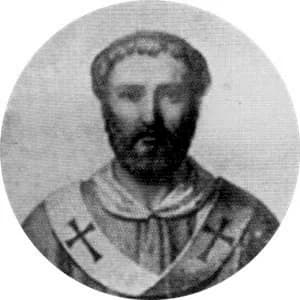
The Byzantine Papacy483-752
Pelagius II
Consecrated in a siege without imperial leave, he begged the Franks to fight the Lombards and died of the plague that made Gregory pope.
Pope no. 63579-590
Pelagius, a Roman whose father bore the Gothic name Unigild, was elected while the Lombards were at the walls in the summer of 579 and consecrated on 26 November without waiting for the emperor's confirmation, because no messenger could reach Constantinople; Tiberius II forgave the breach afterward. His first act was to send the deacon Gregory, the future pope, to the imperial court as his representative with a plea for troops. The court had none to spare. Pelagius turned to the Franks, writing to King Childebert II and to the bishop of Auxerre that God had raised up the Franks as a Catholic people to save Italy from "these most unspeakable Lombards," the first papal appeal to the kingdom that would answer, two centuries later.
The Lombards took a truce in 585 and the pope turned to the church's own wounds. The bishops of Istria and Venetia had been out of communion with Rome since Vigilius accepted the condemnation of the Three Chapters, and Pelagius wrote them three letters, the last drafted by Gregory, arguing that Chalcedon was untouched; when persuasion failed the exarch Smaragdus arrested the patriarch of Grado and forced his submission, which lasted only as long as the soldiers stayed. Pelagius also protested, in vain, when the patriarch John the Faster called himself "ecumenical" at a synod of 588.
The deacon who had carried his letters was elected in his place.
A full essay on this pope is in preparation. The facts and summary above are complete and sourced.
Sources
- J. N. D. Kelly and Michael Walsh, The Oxford Dictionary of Popes (2010)
- Jeffrey Richards, The Popes and the Papacy in the Early Middle Ages, 476-752 (1979)
- Raymond Davis (trans.), The Book of Pontiffs (Liber Pontificalis) (2000)
- Further reading: Wikipedia