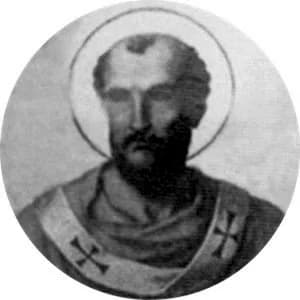
The Byzantine Papacy483-752
Saint Gregory I
The prefect turned monk turned unwilling pope: he fed Rome, sent Augustine to Kent, and called himself servant of the servants of God.
Pope no. 64590-604
Gregory did not want the job and said so to the emperor in writing; the prefect of Rome intercepted the letter, and on 3 September 590 the monk was consecrated bishop of a city half-dead of plague and flood, with the Lombards a day's march away and the emperor's exarch in Ravenna declining to fight them. What he made of the next fourteen years is the reason the church calls him Great and the reason this timeline's Byzantine era has a center. He fed the city from the church's Sicilian estates and kept the books himself. He bought the Lombards off when he could and negotiated with their king as an equal when he could not, and the emperor called him a fool for it. He sent forty monks to convert the English, who repaid the debt by converting the Germans. He refused the patriarch of Constantinople the title "ecumenical" and adopted for himself the one his successors still use, servant of the servants of God.
He also wrote, more than any pope before or after: the Pastoral Rule that every bishop of the Middle Ages was expected to know, the Dialogues that gave the West its Saint Benedict and its picture of purgatory, the commentaries on Job and Ezekiel, the homilies, and some eight hundred and fifty letters that show a sick man running a continent's affairs from a bed. Boniface VIII named him a doctor of the church in 1298 with Ambrose, Jerome, and Augustine. He would have been the first to object to the company.
The prefect who became a monk
He was born around 540 into the senatorial family that had already produced Felix III and Agapetus, in a house on the Caelian hill, and educated in the law and letters of a Rome that Justinian's war had emptied. By 573 he was prefect of the city, the highest civil office left in it. Around 574 he resigned, turned the family house into a monastery dedicated to Saint Andrew, founded six more on the family estates in Sicily, and entered his own as a monk. He later wrote that the years there were the happiest of his life and that he had never recovered from leaving them.
Pelagius II made him a deacon in 578 and sent him to Constantinople as the pope's representative, where he lived for six years, never learned Greek, argued with the patriarch Eutychius about the resurrection of the body, began his commentary on Job for the monks who had come with him, and concluded that no help for Italy would come from the East. Recalled around 586, he became abbot of Saint Andrew's and the pope's adviser, drafting the letters to the schismatic bishops of Istria. Bede tells the story that belongs to these years: Gregory in the Roman slave market, seeing fair-haired boys for sale, asking where they came from, and answering the reply with a pun, not Angles but angels, before setting off to convert them himself and being recalled by a pope who could not spare him.
The plague year
Pelagius II died of plague in February 590, and the clergy elected the abbot. Gregory wrote to the emperor Maurice asking him to withhold confirmation; the prefect, his friend, held the letter back and sent the election notice instead. While the confirmation traveled, Gregory organized the city's response to the plague, a procession in seven columns from seven churches converging on Santa Maria Maggiore, and later legend placed at its end the vision of the archangel Michael sheathing his sword on top of Hadrian's tomb, which has been called Castel Sant'Angelo ever since. He was consecrated on 3 September, and in the sermon he preached that month he compared the pope's office to a ship's captain in a storm, "an old and rotten ship," with the water coming in.
Feeding the city, paying the Lombards
Rome's population had fallen below fifty thousand, the aqueducts were failing, the senate had ceased to meet, and the exarch at Ravenna, who was supposed to defend the city, had neither troops nor money to do it. The church had both. Gregory reorganized the patrimony of Saint Peter, the estates in Sicily, southern Italy, Sardinia, Gaul, and Africa that Pelagius I had put in order, under rectors who reported to him in detail, and used its income to feed the poor, ransom captives, pay the soldiers the emperor did not pay, and buy peace. His letters to the rectors fill a large part of the collection: audits, instructions about tenant farmers not to be overcharged, complaints about a subdeacon's accounts.
The Lombards were the other constant. In 592 the duke of Spoleto marched on Rome and Gregory made a separate truce with him, without the exarch's leave; in 593 King Agilulf himself besieged the city and Gregory bought him off with five hundred pounds of gold from the church's treasury. He wrote to Maurice that he had been made "not a bishop but a paymaster of the Lombards," and Maurice wrote back that the pope was a simpleton. Gregory's reply, that he was indeed a simple man but that the emperor's officers had done nothing, is one of the sharpest letters a pope ever sent an emperor. A general peace came in 598, negotiated by Gregory through Queen Theodelinda, and the Roman church had become, in everything but name, the government of central Italy.
Servant of the servants of God
The quarrel with Constantinople was about a word. The patriarch John the Faster used the title "ecumenical patriarch," which Rome read as a claim to be bishop of the whole world; Gregory protested to John, to the emperor, and to the patriarchs of Alexandria and Antioch, and when the emperor told him the matter was trivial he replied that it was the sin of pride and the forerunner of Antichrist. Against the title he set another. He signed his letters "servant of the servants of God," and the phrase, which he did not invent, became the papacy's own.
No one presumes to teach an art till he has first, with intent meditation, learned it. What rashness is it, then, for the unskilled to assume pastoral authority, since the government of souls is the art of arts.
The humility was real and it was also policy. Gregory never claimed to rule other churches; he claimed that Rome's care extended to all of them, and he acted on it, writing to the bishops of Spain after Reccared's conversion, to the Frankish queen Brunhild about simony, to the bishops of Gaul about Jews forced to baptism, which he forbade, and to the exarch about the schismatic bishops of Istria. He congratulated the usurper Phocas on the murder of Maurice in 602, a letter his admirers have never quite explained, and he told the emperor's officers that a pope who had to choose between the emperor and the church would choose the church.
Forty monks to Kent
In 596 he sent Augustine, prior of his own monastery, with forty monks to Britain, where the pagan Saxons had ruled for a century and a half. The monks got as far as Provence, lost their nerve, and sent Augustine back to Rome to ask to be released; Gregory refused, wrote them letters of encouragement, and wrote to every bishop and ruler along the road. They landed in Kent in 597, where King Ethelbert had a Christian Frankish wife, and by Christmas Augustine had baptized the king and, Gregory boasted to Alexandria, ten thousand of his people.
Gregory's letters to Augustine are a manual for building a church from nothing: a plan for archbishops at London and York with twelve bishops each, which the English adjusted to Canterbury; an instruction to Mellitus in 601 not to destroy the pagan temples but to purify them, to replace the sacrifices with feasts, and to let the people come to God by steps; and answers to a list of practical questions that Bede preserved. The English church that resulted was Rome's own, kept Rome's Easter, and sent Boniface to Germany in the next century; the Whitby life of Gregory called him "our apostle," and the English were the first to call him Great.
The doctor
He was ill for the last five years of his life, with gout and a digestion ruined by fasting, and dictated from his bed. The Dialogues, written in 593 and 594, told the miracles of Italian saints, gave the life of Benedict that is the only early source for it, and set out the doctrine of purgatory that the Latin church would build on; the Homilies on the Gospels were preached to Roman congregations in the plague years; the Pastoral Rule, written in the first months of his reign, was translated into Greek at the emperor's order and into English by King Alfred, and Charlemagne's bishops were required to own it. The chant and the sacramentary that carry his name were attributed to him later; that he cared about the liturgy and reorganized the Roman schola is documented, that he composed the melodies is not.
He died on 12 March 604 and was buried in the porch of Saint Peter's, near Leo, under an epitaph that called him "God's consul." The Romans, who had watched him sell the church's plate to feed them, blamed him for the famine that followed and his successor for charging for grain. The church he left had learned to govern a city and negotiate with kings, and every pope who did either for the next thousand years was doing what Gregory had done first.
Sources
- J. N. D. Kelly and Michael Walsh, The Oxford Dictionary of Popes (2010)
- Eamon Duffy, Saints and Sinners: A History of the Popes (2014)
- R. A. Markus, Gregory the Great and His World (1997)
- John R. C. Martyn (trans.), The Letters of Gregory the Great (2004)
- Gregory the Great, The Book of Pastoral Rule (591) · link
- Bede, Ecclesiastical History of the English People (731) · link
- Further reading: Wikipedia