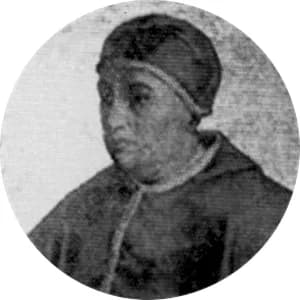
Reformation and Counter-Reformation1513-1605
Leo X
The Medici prince whose brilliant, spendthrift Rome mistook Martin Luther for a passing squabble among friars.
Pope no. 2171513-1521
Giovanni de' Medici was made a cardinal at thirteen and pope at thirty-seven, and he ran the papacy the way his father Lorenzo the Magnificent had run Florence: as the patronage capital of the world. His Rome gave Raphael his greatest commissions and Europe its most dazzling court. It also ran on borrowed money, and one fundraising device, a preached indulgence for the rebuilding of St. Peter's, provoked an obscure German friar named Martin Luther into the protest that split western Christianity. Leo saw the danger late, answered it with formal condemnations rather than reform, and died suddenly in 1521 with the treasury empty and the storm just beginning. Few popes have combined so much cultural glory with so consequential a misjudgment, which is why his eight years matter more than many reigns three times as long.
The Medici prince
Nothing about Leo's rise suggested an apprenticeship in crisis. He was born in 1475, the second son of Lorenzo the Magnificent, and his career was arranged the way Renaissance dynasties arranged everything: tonsured at seven, loaded with benefices as a boy, and created a cardinal in 1489 at thirteen, on the quiet condition that he wait three years before dressing as one. His father's parting letter urged him to be the virtuous exception in a Rome that was, in Lorenzo's phrase, a sink of iniquity. The advice was half-followed: Giovanni was never accused of the violence or the mistresses of the Borgia generation, but austerity was not in the family repertoire.
Exile completed his education. When the Medici were expelled from Florence in 1494, the young cardinal wandered Europe, learned patience, and attached himself to Julius II. He was captured by the French at the battle of Ravenna in 1512, escaped, and within months watched Spanish pikes restore his family to Florence. When Julius II died the following February, the conclave wanted everything Julius was not: peaceable, cultivated, generous. The cardinals elected Giovanni on 9 March 1513. He was not yet a priest; the orders were conferred in the days before his coronation.
Rome as a pleasure and a project
The new pope's court became the wonder and the scandal of Europe at once. Leo hunted in scarlet boots, kept a white elephant named Hanno (a gift from the king of Portugal), staged comedies, and dined magnificently; the remark long attributed to him, that God had given the papacy and it should be enjoyed, is almost certainly apocryphal, but it survived because it fit. The serious side of the same appetite transformed western culture. Raphael painted the Stanze and designed tapestries for the Sistine Chapel; the new St. Peter's rose under his supervision; Greek scholarship, music, and printing flourished under direct papal patronage. For the university of Rome, for Hebrew studies, for the Vatican Library, Leo's pontificate was a golden age.
Politically he played the family hand. The Concordat of Bologna in 1516 traded away Gallican elections to give Francis I control of French church appointments in exchange for a French alliance and papal supremacy on paper; it kept France Catholic in the century ahead, at the price of making the French crown the French church's true master. A war to install his nephew in Urbino drained a fortune. In 1517 a conspiracy to poison him, real or embroidered, ended with a cardinal strangled in Castel Sant'Angelo and Leo packing the college with thirty-one new cardinals in a single day, a maneuver that refilled the treasury through the customary gifts and secured his majorities forever.
All of it cost staggering sums. Leo spent the surplus Julius II left, then the income of future years, then the proceeds of offices invented to be sold. The fundraising apparatus reached into Germany in 1517 as a plenary indulgence for St. Peter's, preached with jingles about souls springing from purgatory the instant coins rang in the chest.
The friar he underestimated
Luther's Ninety-five Theses, posted at Wittenberg in October 1517, objected to precisely that machinery. Leo's first responses have become the textbook case of a great institution misreading a new kind of threat: he reportedly dismissed the affair as a quarrel among friars, delegated it to the Augustinian order, then to a cardinal legate at Augsburg in 1518, and allowed the politics of the imperial election of 1519, in which he needed the German princes, to slow every step. Meanwhile the presses of Germany multiplied Luther's pamphlets by the tens of thousands, in German, for lay readers Rome never thought to address.
The formal machinery eventually produced the bull Exsurge Domine in June 1520, condemning forty-one propositions and giving Luther sixty days to recant. Luther burned it publicly. In January 1521 the bull Decet Romanum Pontificem excommunicated him, and that spring the Diet of Worms placed him under the imperial ban, from which Frederick of Saxony's staged kidnapping rescued him. Leo had won every procedural round and lost Germany. He did grasp, at the end, one piece of the future: in October 1521 he granted Henry VIII, for a book against Luther, the title Defender of the Faith, which English monarchs kept even after breaking with Rome.
What Leo never attempted was the one response that might have mattered: reform of the abuses that gave Luther his audience. The Fifth Lateran Council, inherited from Julius II, closed in 1517 with its reform decrees largely unenforced, months before the Theses appeared. The coincidence has haunted Catholic historians ever since.
The ledger
Leo died of malaria on 1 December 1521, at forty-six, so suddenly that the last sacraments were barely administered and the usual poisoning rumors ran for years. He left the papacy artistically supreme, diplomatically entangled, spiritually discredited in half of Europe, and financially ruined; the conclave that followed had to pawn tapestries to pay its own expenses, and elected as his successor the austere Dutch reformer Adrian VI, the anti-Leo in every particular.
The verdict has hardly moved in five centuries. As a patron, Leo stands with any ruler in European history; the Rome of Raphael is unimaginable without him. As a steward of the church at its most dangerous hour, he was the wrong man with the wrong instincts, a prince of taste asked to answer a prophet of conviction. His own era wrote the epitaph best: he was made for better times, said one contemporary, and the times he actually got were made, in no small part, by him.
Sources
- J. N. D. Kelly and Michael Walsh, The Oxford Dictionary of Popes (2010)
- Eamon Duffy, Saints and Sinners: A History of the Popes (2014)
- Ludwig von Pastor, The History of the Popes from the Close of the Middle Ages, vols. 7-8 (1908)
- Philippe Levillain (ed.), The Papacy: An Encyclopedia (2002)
- Further reading: Wikipedia