The Iron Century903-1046
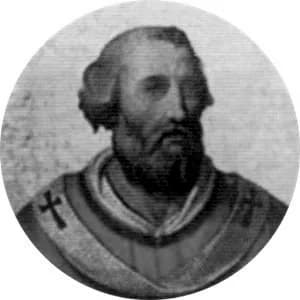
John XII
Prince of Rome and pope at eighteen, he called Otto I in as emperor, turned on him within a year, and was deposed by the emperor's synod.
Pope no. 130955-964
John XII was born Octavian, the son of Alberic II, who had ruled Rome as its prince for twenty-two years, and he inherited both of his father's positions: the city in 954, when Alberic died, and the papacy in December 955, when the Roman nobles kept the oath Alberic had made them swear on his deathbed. He was about eighteen. He took the name John, the second pope to change his name, and he governed, if Liudprand of Cremona is believed, as a prince who happened to be pope: hunting, dice, women in the Lateran, a deacon ordained in a stable. What is certain is that he was a poor general, and that when Berengar II's son Adalbert threatened the papal lands in 960 he did what popes had done since Stephen II and sent north for a protector. Otto I, king of the Germans and victor of the Lechfeld, came to Rome and was crowned emperor by John on 2 February 962, the first emperor in thirty-eight years, and eleven days later sealed the Privilegium Ottonianum, confirming the papal lands and binding the pope-elect to swear to the emperor before consecration.
Within a year John was treating with the Magyars, Constantinople, and Adalbert against the man he had crowned. Otto came back in November 963, John fled to Tivoli with the treasury, and a synod in Saint Peter's under the emperor tried the pope in his absence, deposed him, and elected a layman, Leo VIII, in his place. John returned when Otto left, held a synod of his own, mutilated the men who had testified against him, and died in May 964, of a stroke, Liudprand says, suffered in bed with a married woman. He was twenty-seven. The papacy was the emperor's to confirm for the next century.
Alberic's son
Alberic II had taken Rome from his mother Marozia and her husband Hugh of Provence in 932, when he was about eighteen himself, and ruled it as prince and senator of all the Romans until his death in August 954, keeping four popes in the Lateran as his chaplains and the German king out of Italy. He wanted the two powers reunited in his heir. Octavian, his son by Alda, Hugh's daughter, was already a cleric; on his deathbed Alberic made the Roman nobility and clergy swear at the tomb of Saint Peter that when Agapetus died they would elect the boy. They did, on 16 December 955. He was born about 937, which makes him eighteen; the tradition that makes him sixteen rests on nothing firmer.
The change of name was a statement: the prince Octavian remained, and the pope John was added to him. His first acts were a prince's, a campaign in 958 against Pandulf of Capua and the Byzantine south that failed, and a life at the Lateran that the Roman clergy, or some of them, described to the Germans when the Germans asked.
The emperor's crown
Berengar II, king of Italy, and his son Adalbert began to press on the papal lands in 959, and John, having no army that could stop them, sent to Otto in the autumn of 960 asking him to come and be crowned. Otto had destroyed the Magyar army on the Lechfeld in 955 and was the strongest ruler in the West; he had wanted the imperial title since 951 and had been kept out of Rome by Alberic. He came in the winter of 961, Berengar's army melted, and on 2 February 962 John crowned Otto and his queen Adelaide in Saint Peter's. Otto swore, as Charlemagne's heirs had, to defend the Roman church and its lands and to do nothing in Rome without the pope's consent.
The Privilegium Ottonianum, sealed on 13 February in gold on purple, confirmed the papacy in every territory Pepin and Charlemagne had promised and added more. It also required, in the clause that mattered, that the Romans elect canonically and that the pope-elect take an oath to the emperor before imperial envoys before he was consecrated, as the Constitutio Romana of 824 had required and as no one had enforced for a century.
Treason
Otto went north to besiege Berengar, and John, who had discovered that an emperor in Italy was worse than a king, opened talks with Adalbert, sent envoys to the Magyars inviting them to invade Germany, and wrote to Constantinople. Otto's men intercepted the messengers. When the Romans complained to the emperor of the pope's life, Liudprand reports, Otto answered that he was a boy and would be changed by the example of good men; when the treason came out he sent to ask for an explanation and got, Liudprand says, the answer a boy would give.
He is a boy, and will easily be changed by the example of good men.
In the autumn of 963 Adalbert came to Rome as the pope's guest. Otto marched, and at the beginning of November entered a city that did not fight; John and Adalbert had fled to Tivoli, and John had taken the treasury of Saint Peter's with him.
The synod
On 6 November Otto opened a synod in Saint Peter's with some fifty bishops from Italy and Germany, the cardinals, and the Roman nobility. Liudprand, there as the emperor's interpreter, recorded it. The Romans testified to the charges; the synod wrote to John three times summoning him to answer; John replied, in Latin the bishops mocked, that he excommunicated anyone who tried to depose him; and on 4 December the synod, on the emperor's motion, declared him deposed and elected the head of the papal chancery, Leo, a layman, who was put through the orders and consecrated on 6 December as Leo VIII. The Romans swore never again to elect a pope without the emperor's consent.
It did not hold. In January 964 the Romans rose against the Germans and were cut down; Otto left the city in February, and John came back with his supporters as soon as the emperor's back was turned. Leo VIII fled to the imperial camp. On 26 February John held a synod of his own that annulled Otto's and degraded Leo, and then took his revenge: the cardinal deacon John lost his right hand, the notary Azo his tongue, nose, and two fingers, and Bishop Otgar of Speyer was flogged. Otto was on his way back when, on 14 May 964, John died.
Afterward
The Romans elected Benedict V in his place and Otto besieged them until they gave him up; Leo VIII was restored, and the numbering of the popes has counted both ever since. Otto had made a pope, unmade one, and established that the emperor would confirm every election, a right his successors used until the reformers of the eleventh century took it back. John XII is remembered as the worst pope of the Iron Century, which was Otto's intention and Liudprand's achievement. He was also the pope who revived the empire, an act he undertook to save the Papal States and regretted within a year, and the empire he made would be the papacy's great adversary for two centuries and, in 1046, its rescuer.
Sources
- J. N. D. Kelly and Michael Walsh, The Oxford Dictionary of Popes (2010)
- Eamon Duffy, Saints and Sinners: A History of the Popes (2014)
- Paolo Squatriti (trans.), The Complete Works of Liudprand of Cremona (2007)
- Chris Wickham, Medieval Rome: Stability and Crisis of a City, 900-1150 (2015)
- Peter Llewellyn, Rome in the Dark Ages (1971)
- Philippe Levillain (ed.), The Papacy: An Encyclopedia (2002)
- Further reading: Wikipedia