Reformation and Counter-Reformation1513-1605
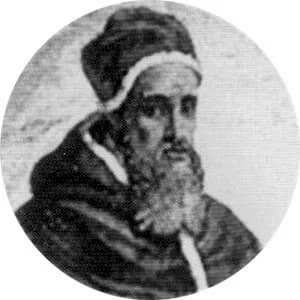
Innocent IX
A capable veteran given sixty-two days, spent steadying finances, policing the Tiber, and dying after a pilgrimage in the rain.
Pope no. 2301591
The third pope in fourteen months, Giovanni Antonio Facchinetti was seventy-two and visibly frail at his election in October 1591, and everyone understood the conclave's arithmetic: a respected, dying veteran acceptable to Spain, to bridge to a real decision. He had earned the respect honestly across a long career: nuncio in Venice, where he helped assemble the Holy League that won at Lepanto, patriarch of Jerusalem in title, a theologian of Trent's generation, and for years the working deputy of the ailing Gregory XIV.
What distinguishes his sixty-two days from the era's other micro-pontificates is how much administration he packed into them. He divided the Secretariat of State into three sections for France, Spain and Italy, and Germany and Poland, an early sketch of the departmental diplomacy the modern Vatican still practices; he moved to curb the sale of offices, ordered retrenchment in the household budgets, restricted the export of grain to keep Roman bread affordable, and set crews to embanking the flood-prone Tiber. Politics allowed no such originality: like his patron he renewed support for Spain and the League against Henry of Navarre. In late December, against all advice, he made a pilgrimage on foot to the seven basilicas in the wet Roman winter, caught a chill, and died on 30 December 1591. The conclave that followed finally elected a young man, and the era's endgame, under Clement VIII, could begin.
A full essay on this pope is in preparation. The facts and summary above are complete and sourced.
Sources
- J. N. D. Kelly and Michael Walsh, The Oxford Dictionary of Popes (2010)
- Eamon Duffy, Saints and Sinners: A History of the Popes (2014)
- Further reading: Wikipedia