Reformation and Counter-Reformation1513-1605
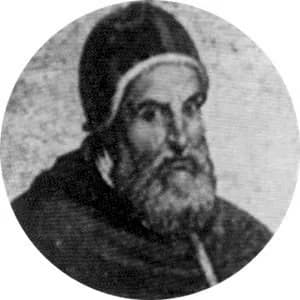
Clement VIII
He absolved Henry IV, freed the papacy from Spain's leash, ran the Jubilee of 1600, and burned Giordano Bruno the same year.
Pope no. 2311592-1605
Ippolito Aldobrandini, a Florentine exile's son and a canon lawyer formed in Philip Neri's circle, gave the era its patient endgame. Elected in January 1592 as yet another candidate acceptable to Spain, he spent his first years proving he was nobody's: when Henry of Navarre abjured Protestantism, Clement read the politics correctly and, in September 1595, absolved him over furious Spanish objection, receiving France back into the church and the papacy back into independence. The bet paid in full. Henry restored Catholicism's position in France, the Peace of Vervins (1598) was brokered under papal mediation, and Rome could again stand between the powers instead of behind one of them; Clement's quiet acceptance of the Edict of Nantes's toleration was the price, paid with a lawyer's silence. The same year, when the Este line failed, he marched a legal claim and an army into Ferrara and annexed it to the Papal States, the papacy's last great territorial acquisition.
His Rome was the workshop pope's: the corrected Clementine Vulgate of 1592 fixed Sixtus V's botched Bible for the next four centuries; fifty-three new cardinals professionalized the college; the Jubilee of 1600 processed some three million pilgrims through a city that could suddenly feed and police them. He worked with a scrupulosity that wore out three secretaries, wept at his own Masses, and dined weekly with Philip Neri's heirs, and Baronius the historian sat as his confessor. The shadows are equally documented: the Inquisition under his reign burned about thirty men, among them Giordano Bruno in the Campo de' Fiori in February 1600, and the Aldobrandini nephews collected fortunes in the old style. He died in March 1605, leaving a papacy solvent, respected, and finally, precariously, neutral: the platform on which the Baroque century would stand.
A full essay on this pope is in preparation. The facts and summary above are complete and sourced.
Sources
- J. N. D. Kelly and Michael Walsh, The Oxford Dictionary of Popes (2010)
- Eamon Duffy, Saints and Sinners: A History of the Popes (2014)
- Ludwig von Pastor, The History of the Popes from the Close of the Middle Ages, vols. 23-24 (1933)
- Further reading: Wikipedia