The Byzantine Papacy483-752
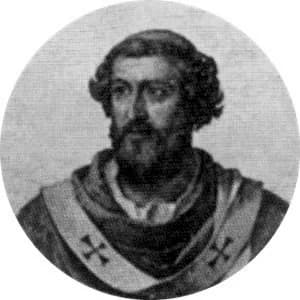
Honorius I
A builder and Gregory's imitator who answered one letter about Christ's will carelessly and became the only pope anathematized by a council.
Pope no. 70625-638
Honorius, a Campanian consul's son, was consecrated two days after his election on 27 October 625 because the exarch was in Rome, and for thirteen years he governed as Gregory the Great's heir: he ran the estates, filled his household with monks, sent Birinus to Wessex, sent the pallium to Canterbury and York, and told the Irish to keep Easter on Rome's date. He also built as no pope had since Constantine. Sant'Agnese outside the Walls, with its apse mosaic in which he holds the church, the Senate house turned into Sant'Adriano, San Pancrazio, the Quattro Coronati, and the bronze roof tiles for Saint Peter's, stripped from the temple of Venus and Rome, are all his.
One letter undid his reputation. In 634 the patriarch Sergius of Constantinople, trying to reconcile the Monophysites by saying Christ had one "operation," asked Honorius's view. Honorius replied that the question was for grammarians, that both "one operation" and "two" should be avoided, and, in a sentence that would be read for centuries, that "we confess one will of our Lord Jesus Christ," since his flesh had never wanted anything contrary to his divinity. Heraclius's edict of 638 imposing the doctrine cited him.
He died on 12 October 638 and was buried in Saint Peter's, and the see he left waited twenty months for a successor the emperor would confirm.
A full essay on this pope is in preparation. The facts and summary above are complete and sourced.
Sources
- J. N. D. Kelly and Michael Walsh, The Oxford Dictionary of Popes (2010)
- Eamon Duffy, Saints and Sinners: A History of the Popes (2014)
- Jeffrey Richards, The Popes and the Papacy in the Early Middle Ages, 476-752 (1979)
- Raymond Davis (trans.), The Book of Pontiffs (Liber Pontificalis) (2000)
- Further reading: Wikipedia