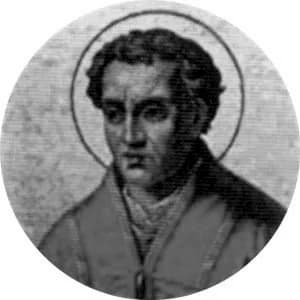
Reform and Investiture1046-1198
Saint Gregory VII
The monk who claimed a pope could depose an emperor, proved it once at Canossa, and died in exile when he tried it a second time.
Pope no. 1571073-1085
For twenty-five years before he was pope, Hildebrand was the most important man in Rome who was not pope. He served five pontiffs, ran the papal finances, went as legate to France and Germany, managed elections, and acquired a reputation for getting his way that made even allies uneasy; Peter Damian, who liked him, called him a holy Satan. When he finally took the office himself in 1073, he used it to assert something no pope had asserted before: that the successor of Peter held authority over every Christian on earth, kings included, and could remove a king who defied him.
He was not the first reformer, and most of his specific measures were inherited. What was new was the conclusion he drew from them. If simony was a heresy, and if lay rulers appointing bishops was the root of simony, then the whole structure by which Europe was governed, the sacral kingship that made the emperor an anointed guardian of the church, was an obstacle to salvation and had to be subordinated. He said so plainly, and Europe spent the next fifty years fighting about it.
Sovana to the Lateran
He was born in southern Tuscany around 1015, of obscure and probably modest family, and raised in Rome at the monastery of Santa Maria on the Aventine, where an uncle was abbot. He became chaplain to Gregory VI, the pope who had bought the papacy from Benedict IX in order to be rid of him, and when Henry III deposed Gregory at Sutri in 1046 Hildebrand went with him into exile at Cologne. He came back in 1049 in the train of Leo IX.
From then on he was permanent staff. Under Leo he handled the patrimony; under Nicholas II he was the man who organised the election at Siena that produced the 1059 decree; under Alexander II he was archdeacon, the senior administrative officer of the Roman church, and the recognised architect of policy. He had also, in Nicholas II's reign, been the negotiator at Melfi who turned the Normans from raiders into papal vassals.
The election
Alexander II died on 21 April 1073. During the funeral in the Lateran the crowd began shouting for Hildebrand, and the cardinals elected him on the spot, that same day, by acclamation.
His first large project was not the empire at all. The Seljuk victory over Byzantium at Manzikert in 1071 had opened Asia Minor, and in 1074 Gregory wrote to the princes of the West proposing that he lead an army east in person to relieve the Greeks and go on to the Holy Sepulchre, leaving the Roman church in the care of Henry IV while he was gone. Fifty thousand men, he claimed, were ready. Nothing came of it, and within eighteen months he and Henry were at war. But the idea of a pope summoning the armed laity of Europe to a war of his own devising had been put on paper, and one of his pupils would carry it out.
Dictatus papae
At the Lenten synod of 1075 Gregory forbade lay investiture outright: no layman, of any rank, was to install a bishop or abbot in office. Since the German king appointed the imperial bishops who governed half his realm, this was not a disciplinary rule but a demand that the empire be reorganised.
Into his register that year was copied a list of twenty-seven bald propositions known as the Dictatus papae. The Roman church was founded by God alone. The pope alone may depose bishops. He alone may use the imperial insignia. All princes shall kiss his feet. He may depose emperors. He may release subjects from their allegiance to an unjust man. He may be judged by no one. The Roman church has never erred, and never will.
Nobody is sure what the list was for: chapter headings for a canon-law collection that was never written, a memorandum, a set of theses to be proved. As a statement of intent it is unambiguous, and Gregory acted on nearly every clause.
What made it explosive was clause twelve. Excommunication was familiar and survivable; kings had been excommunicated before and had made their peace. Deposition was different, because it reached past the man to the office, and it implied that the anointing which made a king sacred was a grant the church could revoke. Every ruler in Europe understood the implication, which is why Gregory found so few of them willing to help him.
Canossa
Henry IV, twenty-five and fresh from crushing a Saxon revolt, appointed his own man to Milan and told Gregory what he thought. In January 1076 the German bishops assembled at Worms and renounced their obedience, addressing him not as pope but as brother Hildebrand, a false monk. Gregory's reply in February was the thing no pope had done. He excommunicated Henry, deposed him, and declared his subjects released from their oaths of allegiance.
It worked, because the German princes wanted it to. They met at Tribur in October and told Henry he had one year to obtain absolution or lose the crown, and invited Gregory to Augsburg to preside over the judgement of their king.
So Henry crossed the Alps in the worst winter in memory and intercepted him first. Gregory was at Canossa, the castle of Matilda of Tuscany in the Apennines, when the king appeared outside the gate in January 1077, barefoot in the wool of a penitent, and stood there for three days asking for absolution. As a priest, Gregory could not refuse a penitent. As a politician, he knew that absolving Henry destroyed the princes' pretext for deposing him. He absolved him.
Canossa entered European memory as the papacy's supreme humiliation of the empire, and Bismarck was still invoking it eight centuries later. At the time it was Henry's victory.
Brixen and the second deposition
The princes elected a rival king, Rudolf of Swabia, anyway. Gregory spent three years refusing to choose between them, and when he finally excommunicated and deposed Henry a second time in March 1080, the gesture had lost its force: the sentence looked partisan, and Rudolf was killed in battle that October.
Henry's answer was a council at Brixen which declared Gregory deposed and named Guibert of Ravenna as pope. Guibert took the name Clement III and would hold Rome, or part of it, for twenty years.
Salerno
Henry besieged Rome from 1081 and entered it in March 1084. Clement III crowned him emperor in Saint Peter's while Gregory held out in the Castel Sant'Angelo, a few hundred yards away, refusing every offer.
Robert Guiscard came north to rescue his overlord with a Norman army that included Muslim troops from Sicily. They broke into the city in May, freed the pope, and then sacked Rome so thoroughly that districts between the Colosseum and the Lateran were left burnt and depopulated for generations. The Romans blamed Gregory, and he had to leave with his rescuers.
He died at Salerno on 25 May 1085, deserted by all but a handful of cardinals, with an antipope in Saint Peter's and his own city half in ashes. By any ordinary measure he had failed completely. The words attributed to him at the end, that he had loved justice and hated iniquity and therefore died in exile, adapt a verse of the psalms and may well be a later composition; they are nonetheless a fair summary. He was canonised in 1606, and the programme he lost in his lifetime was substantially won within forty years of his death.
Sources
- J. N. D. Kelly and Michael Walsh, The Oxford Dictionary of Popes (2010)
- H. E. J. Cowdrey, Pope Gregory VII, 1073-1085 (1998)
- H. E. J. Cowdrey (trans.), The Register of Pope Gregory VII, 1073-1085: An English Translation (2002)
- Uta-Renate Blumenthal, The Investiture Controversy: Church and Monarchy from the Ninth to the Twelfth Century (1988)
- Eamon Duffy, Saints and Sinners: A History of the Popes (2014)
- Further reading: Wikipedia