Reform and Investiture1046-1198
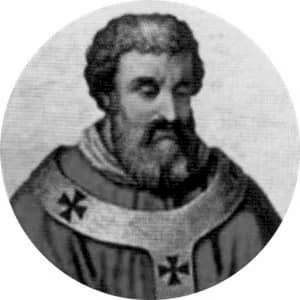
Alexander II
The Milanese who blessed William of Normandy's invasion banner and spent twelve years outlasting an antipope backed by the empire.
Pope no. 1561061-1073
Anselm of Baggio came out of the Pataria, the movement of Milanese artisans and lesser clergy who rioted against married and simoniac priests and were denounced by their own archbishop as a rabble. Made bishop of Lucca, he was elected pope in October 1061 under Nicholas II's new decree, by the cardinals, with Norman soldiers securing the city and no reference to Germany at all.
The imperial court replied by having its own candidate, Cadalus of Parma, proclaimed as Honorius II. The two fought for Rome for three years, and it was only in 1064 that a German council at Mantua settled the matter for Alexander, less on principle than because Anno of Cologne had taken over the regency and preferred him.
Alexander then governed for a decade with Hildebrand as archdeacon and effective chief of staff. He backed the Pataria openly against the Milanese hierarchy, pushed legates into Spain and France, forbade the forced baptism of Jews in a letter later quoted for centuries, and in 1066 sent William of Normandy a papal banner for the conquest of England, treating a disputed throne as something a pope could adjudicate.
He died in April 1073 with a summons out against Henry IV's counsellors. At his funeral the Roman crowd shouted for Hildebrand, and got him.
A full essay on this pope is in preparation. The facts and summary above are complete and sourced.
Sources
- J. N. D. Kelly and Michael Walsh, The Oxford Dictionary of Popes (2010)
- Eamon Duffy, Saints and Sinners: A History of the Popes (2014)
- I. S. Robinson, The Papacy 1073-1198: Continuity and Innovation (1990)
- Further reading: Wikipedia