The Global Papacy1958-present
Francis
The Jesuit from Buenos Aires who took the papacy out of the palace, toward the peripheries, and reopened arguments the council had left.
Pope no. 2662013-2025
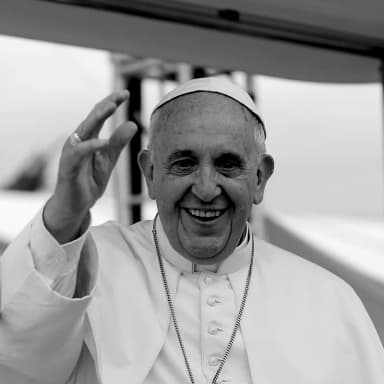
Jorge Mario Bergoglio was the first pope from the Americas, the first Jesuit, the first to take the name of Francis of Assisi, and the first in more than a millennium to come from outside Europe. Elected in 2013 to clean up after a resignation, he governed for twelve years as a disruptor: he moved out of the papal apartments, made his first journey to an island of drowned migrants, wrote an encyclical on the climate that entered secular politics, and opened questions on marriage, sexuality, and the Latin Mass that his two predecessors had considered closed. He restructured the curia, prosecuted a cardinal, and forced the church's bishops into a global process of consultation he called synodality. Admirers saw the council finally completed; critics saw confusion elevated to method. He died on Easter Monday 2025, the day after blessing a full Saint Peter's Square from a wheelchair, and asked to be buried across town, in a plain tomb marked with one word.
Buenos Aires
He was born on 17 December 1936 in the Flores district of Buenos Aires, the eldest of five children of Piedmontese immigrants, and trained as a chemical technician before a confession at seventeen turned him toward the priesthood. A severe lung infection at twenty-one cost him part of one lung. He entered the Jesuits in 1958, was ordained in December 1969, and at thirty-six, in 1973, became provincial of the order in Argentina, a post he held through the years of the military dictatorship.
His governance of the province divided the Argentine Jesuits deeply enough that the order sent him into internal exile in Córdoba from 1990 to 1992, a period he later described as a purification. Rescue came from the archbishop of Buenos Aires, who made him an auxiliary bishop in 1992; he succeeded to the see in 1998 and became a cardinal in 2001. The Bergoglio the world would meet was formed here: a bishop who rode the subway, sent priests to live in the shantytowns, denounced the political class's corruption, and drafted the Latin American bishops' 2007 Aparecida document, with its call for a church of missionary disciples that goes out to the margins. He was, by most accounts, the runner-up in the conclave of 2005.
Buonasera
On 13 March 2013, on the fifth ballot, the cardinals elected a seventy-six-year-old who had come to Rome expecting to retire. He walked onto the loggia in a plain white cassock, said "Buonasera," and asked the crowd to pray over him before he blessed them. He kept his old black shoes, paid his own hotel bill, declined the Apostolic Palace for a room in the Vatican guesthouse, and washed the feet of young prisoners, two of them Muslim, two of them women, on his first Holy Thursday. He explained the name a few days after the election: Francis of Assisi, the man of the poor and of peace, "how I would like a church that is poor and for the poor."
The first journey, on 8 July 2013, was to Lampedusa, where he threw a wreath into the sea for the migrants who had drowned trying to reach Europe and named "the globalization of indifference." Two weeks later, asked on the plane home from Rio about a gay priest, he answered "Who am I to judge?" and the pontificate's public register was set. Evangelii gaudium (November 2013), the program document, asked for a church that is "bruised, hurting and dirty because it has been out on the streets" rather than one "clinging to its own security."
I prefer a Church which is bruised, hurting and dirty because it has been out on the streets, rather than a Church which is unhealthy from being confined and from clinging to its own security.
The program
Laudato si' (May 2015), the first encyclical devoted to the environment, treated climate change as a moral question binding on believers and unbelievers alike and landed, by design, months before the Paris climate conference; it was quoted by heads of state and denounced by others. Two synods on the family produced Amoris laetitia (2016), whose cautious opening to communion for some divorced and remarried Catholics, lodged in a footnote, prompted four cardinals to publish formal doubts and started the pontificate's long guerrilla war with its conservative critics. Fratelli tutti (2020) on human fraternity followed the Abu Dhabi declaration he signed with the grand imam of al-Azhar in 2019.
He reorganized the curia (Praedicate evangelium, 2022), put laypeople and women in charge of Vatican departments, and forced through financial reforms that ended with a cardinal, Angelo Becciu, convicted of embezzlement by a Vatican court in 2023. He signed a provisional agreement with China on the appointment of bishops in 2018 that critics called a surrender. In 2021 Traditionis custodes reversed Benedict XVI's liberalization of the Latin Mass; in 2023 Fiducia supplicans permitted informal blessings of same-sex couples and was rejected by the bishops of Africa as a body. The synod on synodality (2021-2024), with voting laypeople and women in the hall for the first time, was the pontificate's method made institution: consult everyone, decide slowly, keep the questions open.
The wounds
The abuse crisis tested him as it had his predecessor, and his record is uneven. In Chile in January 2018 he defended a bishop accused of covering for a notorious abuser and dismissed the accusers' claims as calumny; within months, after reading an investigator's report, he apologized, summoned every Chilean bishop to Rome, and accepted the resignations of many. In 2019 he laicized Theodore McCarrick, the former cardinal archbishop of Washington, convened the world's bishops to a summit on abuse, abolished the pontifical secret in abuse cases, and made bishops legally accountable for cover-ups for the first time. Survivors credited the laws and faulted the enforcement; the case of the Jesuit artist Marko Rupnik dragged into his final years.
The opposition was unlike anything a modern pope had faced from inside his own church. A former nuncio to Washington published a letter in 2018 demanding his resignation, cardinals signed public dubia, American Catholic media built an industry on his supposed heterodoxy, and the pope answered with silence, humor, and occasional sharpness about "backwardism." He excommunicated the former nuncio for schism in 2024. Progressives, meanwhile, noted that the doctrine had not actually changed: no women deacons, no married priests for the Amazon, the same teaching on contraception and marriage. He had moved the church's tone and its center of gravity, not its rulebook, and seemed to think that was the harder and more important thing.
Journeys and the last years
He made forty-seven journeys outside Italy: to Iraq in 2021, the first pope ever; to Mongolia's fifteen hundred Catholics; to Canada in 2022 to apologize to Indigenous peoples for the residential schools; to Lesbos, from which he flew three Syrian Muslim families home to Rome. During the pandemic, on 27 March 2020, he prayed alone in a deserted, rain-swept Saint Peter's Square before a plague crucifix, and the image became the pontificate's icon.
Age and illness closed in from 2021: colon surgery, a knee that put him in a wheelchair, repeated bronchitis, and finally, on 14 February 2025, a hospitalization for double pneumonia that lasted thirty-eight days and brought him twice near death. He came home to the Vatican in March, appeared without warning in Saint Peter's on Easter Sunday, 20 April, to give the blessing and ride once more through the crowd, and died the next morning of a stroke and heart failure, at eighty-eight. Some 250,000 people filled the square for the funeral on 26 April, and his coffin was driven through Rome to Santa Maria Maggiore, the Marian basilica he had visited before and after every journey, to lie under a stone inscribed only "Franciscus." He was the first pope in more than a century to be buried outside the Vatican, and the first, perhaps ever, to be mourned as much by people who did not share his faith as by those who did.
Sources
- Eamon Duffy, Saints and Sinners: A History of the Popes (2014)
- Austen Ivereigh, The Great Reformer: Francis and the Making of a Radical Pope (2014)
- Austen Ivereigh, Wounded Shepherd: Pope Francis and His Struggle to Convert the Catholic Church (2019)
- Holy See Press Office, Biography of the Holy Father Francis · link
- Further reading: Wikipedia