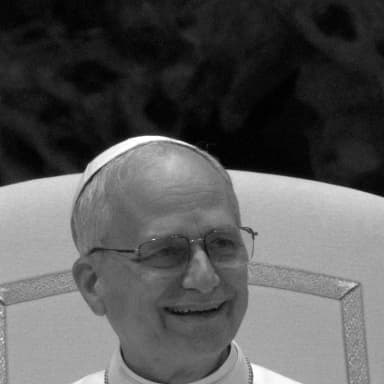
The Global Papacy1958-present
Leo XIV
The Chicago-born Augustinian and Peruvian missionary elected in 2025 as the first American pope, with the machine age as his chosen theme.
Pope no. 2672025-present
For a century the received wisdom held that the cardinals would never elect a pope from the world's dominant power. On 8 May 2025 they elected one, and the surprise lasted about a day, because Robert Prevost turned out to be an American of an unusual kind: a mathematics graduate from the Chicago suburbs who had spent two decades as a missionary and bishop in northern Peru, held Peruvian citizenship, led a five-continent religious order from Rome for twelve years, and had been Francis's choice to vet the world's bishops. He took the name Leo in deliberate homage to Leo XIII, the pope of the first industrial revolution, and announced that the church now faced a second one in artificial intelligence. Sixteen months in, the pontificate has produced its first encyclical on exactly that theme, four journeys across three continents, and the first formal schism declared by Rome in a generation. This profile is written from inside a reign still in progress; its last section will need rewriting.
Two shores
He was born on 14 September 1955 at Mercy Hospital in Chicago and raised in Dolton, a working-class suburb on the city's south edge, the youngest of three sons of a Navy veteran turned school superintendent and a librarian with Louisiana Creole roots. The family was parish-centered and Augustinian by geography: the friars ran the nearby schools, and Robert entered their high-school seminary in Michigan at fourteen. He took a mathematics degree at Villanova in 1977, joined the Order of Saint Augustine that September, and was ordained in Rome on 19 June 1982, going on to a doctorate in canon law at the Angelicum with a dissertation on the authority of the local prior. Nothing in that record predicts a pope, and nothing in it predicts Peru.
Peru claimed him in 1985. He went first to the dusty prelature of Chulucanas, then, from 1988, spent a decade in Trujillo running the Augustinian seminary, teaching canon law, judging marriage cases, and serving as a parish priest in a barrio on the city's edge, through Peru's years of political violence and the Fujimori regime, whose abuses he criticized. Recalled to Chicago as provincial in 1999, he was elected prior general of the whole order in 2001 and re-elected in 2007: twelve years based in Rome, visiting Augustinian houses on every continent and learning the church as a global institution rather than a national one. Francis sent him back to Peru in 2014 as bishop of Chiclayo, a diocese of farmers and fishermen where he took Peruvian citizenship, organized relief during the 2017 floods, and carried the diocese through the pandemic.
The bishop-maker
In January 2023 Francis brought him to Rome to run the Dicastery for Bishops, the office that proposes every episcopal appointment in the Latin church, and made him a cardinal that September. It was the most consequential apprenticeship a future pope could serve: two years of reading the files of every candidate for every diocese on earth, and of sitting on the Pontifical Commission for Latin America, gave him a map of the church that no other cardinal possessed. It also gave him a record. Two abuse-handling controversies from his past have followed him into the papacy.
Francis's death on 21 April 2025 sent 133 cardinal electors into conclave on 7 May, the largest and most geographically scattered electorate in history, most of them appointed by the dead pope and many meeting one another for the first time. The favorites were Italian. On the fourth ballot, in the early evening of 8 May, white smoke rose for the American, and an hour later Cardinal Mamberti pronounced a name the square did not recognize.
Leo
His first words from the loggia were "Peace be with you all," and he wore the red mozzetta Francis had declined. Two days later he explained the name to the cardinals.
In our own day, the Church offers to everyone the treasury of her social teaching in response to another industrial revolution and to developments in the field of artificial intelligence that pose new challenges for the defence of human dignity, justice and labour.
The choice announced a method as much as a theme. Leo XIII had answered the factory age not with denunciation but with a doctrine, Rerum novarum, that gave the church a place in the argument about work and wages for a century. His namesake proposes to do the same for the age of intelligent machines. The first year has been consistent with a canon lawyer's temperament: fewer improvisations than Francis, more written acts, a return to the Apostolic Palace and to summers at Castel Gandolfo, and an insistence that Francis's synodality be paired with the older word collegiality, meaning that the bishops, not only the assembled people, govern with the pope. He kept Francis's social teaching intact, completed the exhortation on the poor his predecessor had left in draft, Dilexi te, and published it in October 2025. He canonized the two young laymen Francis had scheduled, Carlo Acutis and Pier Giorgio Frassati, in September 2025. He has appointed women to posts no woman had held, including, in June 2026, the first laywoman to run a Vatican dicastery.
The traveling year
He went first to the East. In November 2025 he flew to Turkey to mark the 1,700th anniversary of the Council of Nicaea alongside the Ecumenical Patriarch Bartholomew, visited Istanbul's Blue Mosque, and continued to Lebanon, where he stood at the site of the 2020 port explosion. In April 2026 he made the first papal visit to Algeria and went to Annaba, the ancient Hippo, to say Mass at the basilica of the saint whose rule he has lived under since he was twenty-two; the same journey took him to Cameroon, Angola, and Equatorial Guinea, where he spoke against corruption and what he called an economy of exclusion. In June 2026 Spain: Madrid, the Canary Islands, and Barcelona, where on the centenary of Antoni Gaudí's death he inaugurated the newly completed tower of Jesus Christ that made the Sagrada Família the tallest church in the world.
Between the journeys came the encyclical. Magnifica humanitas, signed on 15 May 2026 and released ten days later, is subtitled "on safeguarding the human person in the time of artificial intelligence." It places the new technology inside the tradition of social teaching that runs from Rerum novarum through Laudato si', and asks that it be judged by what it does to human dignity, to labor, and to the common good. It is the first encyclical whose subject did not exist when its author was ordained.
The line drawn
The pontificate's hardest moment came from the church's own right flank. The Society of Saint Pius X, the traditionalist body founded in the wake of the council, whose bishops had been excommunicated in 1988 and had their excommunications lifted by Benedict XVI in 2009, announced that it would consecrate new bishops without papal mandate. Rome warned in May 2026 that the act would be schismatic. On 1 July 2026, at Écône in Switzerland, the Society consecrated four men anyway. The next day the Holy See declared the consecrating and consecrated bishops excommunicated and the Society's clergy in schism, and warned lay Catholics who formally adhered to it of the same penalty. It was the end of a forty-year effort, pursued by three of his predecessors, to keep the door open, and Leo closed it with the brevity of a lawyer reading a judgment.
That is where the record stands in September 2026: a pope of two hemispheres, sixteen months into the office, who has so far disappointed those who hoped he would reverse Francis and those who hoped he would go faster, and who has chosen as his central subject a question no pope before him could have asked. Everything after this sentence belongs to the future.
Sources
- Holy See Press Office, Biography of the Holy Father Leo XIV (2025) · link
- Leo XIV, Dilexi te: Apostolic Exhortation on Love for the Poor (2025) · link
- Leo XIV, Magnifica humanitas: Encyclical Letter on Safeguarding the Human Person in the Time of Artificial Intelligence (2026) · link
- Vatican News, Excommunication decreed for Lefebvrite episcopal ordinations (2026) · link
- Further reading: Wikipedia