The Global Papacy1958-present
Benedict XVI
The shy Bavarian theologian who guarded doctrine for a quarter century, then did what no pope had freely done in 700 years: he resigned.
Pope no. 2652005-2013
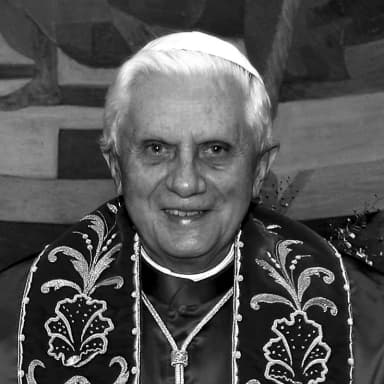
Joseph Ratzinger was the most learned man to hold the papacy in centuries and, by his own account, the least suited to wanting it. A Bavarian professor who had helped write the Second Vatican Council's documents and then spent twenty-three years as John Paul II's doctrinal guardian, he was elected at seventy-eight to consolidate a long pontificate rather than begin one. He wrote luminous encyclicals on love and hope, restored the old Latin Mass to anyone who wanted it, and lectured secular Europe on the reasonableness of faith. He also inherited the clerical abuse crisis at full flood and a curia he could not govern, and on 11 February 2013 he did what no pope had done freely since 1294: he announced he was leaving. The resignation, not the theology, is what changed the office. Every pope after him serves knowing that the chair can be vacated by choice.
A Bavarian formation
He was born on Holy Saturday, 16 April 1927, in the village of Marktl am Inn, the son of a rural policeman whose open dislike of the Nazis kept the family moving from posting to posting. Membership in the Hitler Youth became compulsory when he was fourteen; at sixteen he was drafted into an anti-aircraft unit, and in the spring of 1945 he deserted and walked home, spending a few weeks in an American prisoner-of-war camp before release. He and his brother Georg were ordained together on 29 June 1951, and Joseph turned at once to the academy: a doctorate on Augustine, a habilitation on Bonaventure that his examiner nearly failed, and professorships at Bonn, Münster, Tübingen, and Regensburg by the age of forty-two.
At the council he served as theological adviser to Cardinal Frings of Cologne and belonged to the reforming majority; his Introduction to Christianity (1968) is still in print. Then came 1968 itself. The student revolt at Tübingen, where he watched Marxist slogans invade theology faculties, convinced him that the council's opening had been hijacked by a spirit that dissolved rather than renewed, and the progressive peritus became the movement's most articulate critic. He co-founded the journal Communio in 1972 as a counterweight to Concilium. The shift was less a conversion than a decision about which danger was greater.
The guardian
Paul VI made him archbishop of Munich in March 1977 and a cardinal three months later, and in November 1981 John Paul II called him to Rome as prefect of the Congregation for the Doctrine of the Faith. He stayed nearly a quarter century. The office had been called the Holy Office and, before that, the Inquisition, and its prefect became the most feared man in Catholic theology: the instructions on liberation theology (1984 and 1986), the disciplining of Leonardo Boff and Charles Curran, the declaration Dominus Iesus (2000) on the uniqueness of Christ that dismayed ecumenical partners, and the drafting oversight of the 1992 Catechism all carried his signature. In 2001 he persuaded the pope to route every clerical abuse case in the world through his congregation, which is how he came to read the files that would define his own reign; in 2004 he reopened the case against Marcial Maciel that others had buried.
By the time John Paul II died, Ratzinger was dean of the college of cardinals, the man who preached at the funeral and, at the Mass before the conclave, warned against a "dictatorship of relativism." Four ballots later, on 19 April 2005, the cardinals chose the preacher.
The professor pope
He took the name Benedict for the pope who had pleaded for peace in the First World War and for the monk whose rule had preserved Europe's learning, and he governed like a man who would rather have been writing. Deus caritas est (2005), Spe salvi (2007), and Caritas in veritate (2009) are among the most read encyclicals of the modern era; a three-volume Jesus of Nazareth, written in his spare hours, was a bestseller. His Regensburg lecture of 12 September 2006 quoted a Byzantine emperor's harsh words about Muhammad set off protests across the Muslim world and, possibly in reprisal, the murder of a nun in Somalia, then produced, in the letter of 138 Muslim scholars called A Common Word, the most serious Christian-Muslim exchange in decades. Summorum Pontificum (2007) freed the pre-conciliar Latin Mass from episcopal permission; Anglicanorum coetibus (2009) created structures for Anglicans entering the Catholic Church as groups. He made some two dozen foreign journeys, drew a million young people to Cologne, Sydney, and Madrid, and prayed in the Blue Mosque in Istanbul.
The instincts of the scholar served him less well as a ruler. Lifting the excommunications of four traditionalist bishops in 2009 without anyone checking that one of them, Richard Williamson, had just denied the Holocaust on television was the pontificate's characteristic misstep: right in intention, unguarded in execution, and left to others to explain.
The crisis
The abuse scandal that had broken in Boston in 2002 arrived in Europe in 2010. Government reports in Ireland documented systematic concealment; Benedict's own former archdiocese of Munich was found to have reassigned an abuser during his tenure in 1980. He responded as no pope had: a letter to the Catholics of Ireland in March 2010 that named the bishops' failures, meetings with victims on nearly every journey, revised norms that made concealment itself an offense, and the laicization of roughly four hundred priests in his final two years. It was more than his predecessor had done and less than the moment demanded, and the question of his personal responsibility in Munich followed him to the grave.
Rome itself, meanwhile, was coming apart. In 2012 his own butler leaked private papers to the press, exposing a curia riven by feuds over money and appointments; the Vatican bank was under investigation; a secret report on the whole affair landed on his desk in December. He was eighty-five.
The renunciation
On 11 February 2013, at a routine consistory to approve canonizations, he read a short statement in Latin. Most of the cardinals in the room did not immediately grasp what they had heard.
I have come to the certainty that my strengths, due to an advanced age, are no longer suited to an adequate exercise of the Petrine ministry.
The resignation took effect at eight in the evening on 28 February. He flew by helicopter to Castel Gandolfo as the bells of Rome rang, told the crowd he was now "simply a pilgrim beginning the last leg of his pilgrimage on earth," and disappeared into a monastery inside the Vatican walls. The church had to invent a status for him: pope emeritus, still in white, still called Holiness, publicly silent by promise and mostly so in practice, though a 2019 essay on the roots of the abuse crisis and a 2020 book on celibacy reminded everyone that two men in white lived a few hundred meters apart.
He lived almost ten more years, dying on the last morning of 2022, at ninety-five. Francis presided at his funeral on 5 January 2023, the first time in the modern age that a pope had buried his predecessor. The judgment on the pontificate is unsettled and probably always will be: a thinker of the first rank in a job that rewards governors, a reformer on abuse who could not reform the institution that let it happen, a conservative who committed the most radical act of the modern papacy. He had asked the cardinals in 2005 to pray that he not flee for fear of the wolves. In the end he did not flee. He set the office down, carefully, and showed that it could be done.
Sources
- J. N. D. Kelly and Michael Walsh, The Oxford Dictionary of Popes (2010)
- Eamon Duffy, Saints and Sinners: A History of the Popes (2014)
- Peter Seewald, Benedict XVI: A Life (2 vols.) (2021)
- Joseph Ratzinger, Milestones: Memoirs 1927-1977 (1998)
- Further reading: Wikipedia