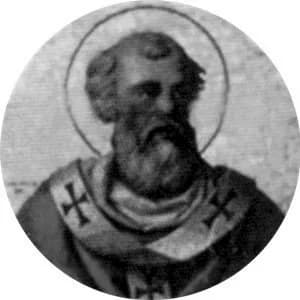
The Byzantine Papacy483-752
Saint Felix IV
Theodoric's choice, who settled the doctrine of grace for the West, built a church in the Forum, and tried to hand the papacy to his deacon.
Pope no. 54526-530
After John I died in Theodoric's prison the see stayed empty for two months while the king made his wishes known, and on 12 July 526 the Roman clergy elected the man he wanted, Felix, a priest from Samnium and a friend of the Gothic court. Theodoric died six weeks later, and Felix spent his reign under the regency of the king's daughter Amalasuntha, who was kind to the church: she gave him two buildings in the Forum, the temple of Romulus and a hall of Vespasian's forum of peace, which he turned into the church of Saints Cosmas and Damian. Its apse mosaic, with Felix presenting the church to Christ, is the oldest surviving portrait of a pope made in his lifetime, though restorers have had their way with the face.
His one doctrinal act was decisive. Asked by Caesarius of Arles for help against the semi-Pelagians of southern Gaul, who held that the first movement toward God was a human act, Felix sent a set of propositions drawn from Augustine and Prosper, and the Council of Orange in 529 adopted them as its canons: grace comes first, and even the desire for faith is God's gift. Boniface II confirmed the council, and the Latin church has taught that doctrine since.
He died on 22 September 530 and was buried in Saint Peter's. His feast is kept on the same day.
A full essay on this pope is in preparation. The facts and summary above are complete and sourced.
Sources
- J. N. D. Kelly and Michael Walsh, The Oxford Dictionary of Popes (2010)
- Jeffrey Richards, The Popes and the Papacy in the Early Middle Ages, 476-752 (1979)
- Raymond Davis (trans.), The Book of Pontiffs (Liber Pontificalis) (2000)
- Further reading: Wikipedia