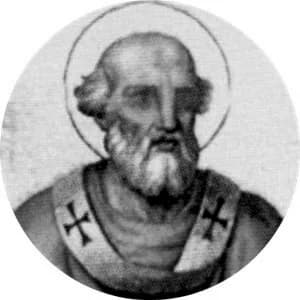
The Byzantine Papacy483-752
Saint John I
The first pope to visit Constantinople, sent by an Arian king to plead for Arians, who crowned an emperor and died in the king's prison.
Pope no. 53523-526
John, an elderly Tuscan deacon and possibly the John to whom Boethius dedicated his theological treatises, was elected on 13 August 523 and spent his last years as the instrument of a king who did not trust him. In 523 the emperor Justin I began closing Arian churches in the East and forcing Arians to convert. Theodoric, the Arian king of Italy, whose Gothic people were Arian, took it as a threat, and in 525 he sent the pope to Constantinople at the head of an embassy of senators and bishops to demand that the persecution stop and the converts be allowed to return to their old faith.
No pope had ever gone to the imperial city, and the city received him as Peter's successor. Justin met him at the gate, prostrated himself, and had John crown him a second time at Easter 526; the patriarch gave him the higher seat. John obtained most of what Theodoric wanted, the churches reopened and forced conversion ended, but he would not ask that converts be sent back to heresy, and Theodoric, who had executed Boethius the year before and the senator Symmachus that spring, decided the pope had gone over to the emperor. When John returned to Ravenna he was imprisoned, and there, on 18 May 526, worn out by the journey and the treatment, he died.
He had sat in Peter's chair for under three years and spent much of it at sea, the first pope to see Constantinople and the only one for two centuries whom an emperor received on his knees.
A full essay on this pope is in preparation. The facts and summary above are complete and sourced.
Sources
- J. N. D. Kelly and Michael Walsh, The Oxford Dictionary of Popes (2010)
- Eamon Duffy, Saints and Sinners: A History of the Popes (2014)
- Raymond Davis (trans.), The Book of Pontiffs (Liber Pontificalis) (2000)
- Further reading: Wikipedia