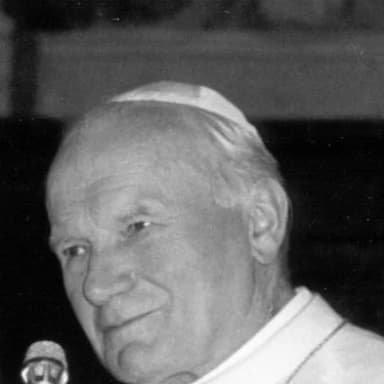
The Global Papacy1958-present
Saint John Paul II
The pope from Kraków who turned the office into a global stage and helped bring down the empire that had ruled his homeland.
Pope no. 2641978-2005
Karol Wojtyła was the first non-Italian pope in four and a half centuries, the first from a Slavic nation, and the first who had spent his whole adult life under totalitarian rule. He arrived in 1978 as a fifty-eight-year-old unknown and left in 2005 as the most recognizable human being on earth. In between he visited 129 countries, wrote fourteen encyclicals, survived an assassin's bullets, helped pull down the Soviet empire, canonized more saints than all his predecessors combined since the process was formalized, and turned the papacy into a mass medium. He also centralized authority, closed arguments the council had left open, and presided, in his last years, over the surfacing of the clerical abuse crisis that his successors would have to answer. Twenty-six and a half years is the third longest pontificate in history, and it is hard to name one that changed the office more.
The apprenticeship
He was born in Wadowice, a small town near Kraków, on 18 May 1920, into a Poland that had existed as a state for eighteen months. Loss came early: his mother died when he was eight, his older brother, a doctor, at twelve, and his father, a retired army officer who had raised him in a two-room flat, in 1941, leaving him alone at twenty. By then the Germans had closed the Jagiellonian University where he studied literature, and Wojtyła was breaking rocks in a quarry and hauling buckets at the Solvay chemical works to avoid deportation, writing plays for an underground theater at night. In 1942 he entered Kraków's clandestine seminary, run by the archbishop from his own residence; he was ordained on 1 November 1946, the day after All Saints, and sent to Rome for a doctorate.
The philosopher formed in the 1950s under communism was a distinctive one. He taught ethics at Lublin, the only Catholic university in the Soviet bloc, wrote on love and responsibility, and took students kayaking in the Masurian lakes, saying Mass on an overturned boat. Pius XII made him an auxiliary bishop at thirty-eight; at the Second Vatican Council he contributed to the documents on religious liberty and on the church in the modern world. Archbishop of Kraków from 1964 and cardinal from 1967, he fought the regime with patience rather than confrontation, winning after a twenty-year struggle the right to build a church in the model socialist town of Nowa Huta, which had been designed without one.
Habemus papam
The conclave of October 1978, the second in two months, deadlocked between two Italians and turned on the third day to the cardinal from Kraków. Announced on 16 October, John Paul II broke with protocol at once, addressing the crowd in imperfect Italian and asking them to correct him. At his inauguration six days later he set the theme of the pontificate.
Be not afraid! Open wide the doors for Christ.
The world found out what the words meant in June 1979, when he went home. The communist government, unable to refuse and unable to control, watched a third of Poland's population turn out to see him over nine days; in Warsaw's Victory Square he prayed that the Spirit would "renew the face of the earth, this land," and the crowd of a quarter million chanted back "We want God." Fourteen months later the Solidarity trade union was born in the Gdańsk shipyards, with the pope's portrait on its gates. Through the martial law of 1981, the murder of Father Jerzy Popiełuszko in 1984, and the round-table negotiations of 1989, he supplied the movement with moral legitimacy and the regime with a problem it could not solve.
On 13 May 1981 Mehmet Ali Ağca shot him twice in Saint Peter's Square. He lost most of his blood, survived five hours of surgery, and two years later sat with his attacker in his prison cell. Who, if anyone, stood behind Ağca has never been settled.
The teacher
For all the drama abroad, John Paul II was a professor at heart, and he taught relentlessly. Fourteen encyclicals ran from Redemptor hominis in 1979 to Ecclesia de Eucharistia in 2003, with Laborem exercens, Sollicitudo rei socialis, and Centesimus annus building a social teaching that condemned communism and unchecked capitalism together. Veritatis splendor (1993) and Evangelium vitae (1995) defended objective moral truth and the inviolability of life against what he called a culture of death; Fides et ratio (1998) insisted that faith and reason needed each other. Between 1979 and 1984 he devoted 129 Wednesday audiences to a "theology of the body," a meditation on sexuality and the human person that a generation of Catholic teachers would take up after his death. He promulgated a new Code of Canon Law in 1983 and the first universal Catechism since Trent in 1992, and in 1994 declared the question of women's ordination closed.
The same conviction had a disciplinary face. Hans Küng lost his license to teach as a Catholic theologian in 1979; liberation theologians in Latin America were investigated and, in some cases, silenced; bishops were chosen for doctrinal reliability, and the doctrinal office under Cardinal Joseph Ratzinger became the pontificate's engine room. Admirers saw a church that finally knew what it believed again after two decades of drift. Critics saw the collegiality promised at the council quietly recentralized in Rome. Both were describing the same thing.
The world as a parish
He was the most traveled pope in history by a margin that will not be closed: 104 journeys outside Italy, more than a million kilometers, stadium crowds on every continent, a World Youth Day invented in 1985 that drew five million to Manila ten years later. The travel had a purpose beyond spectacle. He went where Catholics were persecuted or forgotten, and where the church's past required repair. In April 1986 he became the first pope known to have entered a synagogue, calling Jews "our elder brothers"; that October he gathered the leaders of the world's religions to pray for peace at Assisi. He established diplomatic relations with Israel in 1993, slipped a note asking forgiveness into the Western Wall in 2000, and in 2001 became the first pope to enter a mosque, in Damascus. He opposed both Gulf wars publicly.
The Jubilee of 2000 was the pontificate's summit. On 12 March of that year, the Day of Pardon, he asked forgiveness for the sins of Christians across two millennia: the Crusades, the Inquisition, the treatment of Jews, of women, of the poor. No pope had ever spoken that way about the institution he led. He canonized 482 saints and beatified some 1,340 others, deliberately populating heaven with laypeople, married couples, and martyrs of the twentieth century so that holiness would look like something ordinary Catholics could attempt.
The long goodbye
Parkinson's disease was visible by the mid-1990s and undeniable by 2000; a broken hip in 1994 had already cost him the vigor that was part of his public persona. He refused to hide it or to resign, reportedly asking whether Christ had come down from the cross, and his decade of decline became the most public dying of the age, a sermon on suffering delivered without words. The final years also brought the scandal that would define the next pontificate: the Boston revelations of 2002 exposed decades of concealed abuse by priests, and it later emerged that Rome under John Paul II had protected favored figures, most damagingly Marcial Maciel, founder of the Legionaries of Christ, whose crimes were confirmed only after the pope's death. How much he knew, and how much his own experience of communist smear campaigns against priests disposed him to disbelieve accusers, remains argued.
He died in his apartment on the evening of 2 April 2005, with the square below full and silent. An estimated four million people came to Rome for the funeral on 8 April, the largest gathering of heads of state in history, and the crowd's chant of "Santo subito," sainthood now, was answered faster than any in modern times: beatified by his successor in 2011 and canonized by Francis on 27 April 2014, alongside John XXIII. The verdict remains double. He was the pope who gave the office a global voice and used it against tyranny, and the pope whose confidence in the institution kept him from seeing its gravest internal wound. Both belong to the same man, which is why the argument about him is really an argument about the century he led the church through.
Sources
- J. N. D. Kelly and Michael Walsh, The Oxford Dictionary of Popes (2010)
- Eamon Duffy, Saints and Sinners: A History of the Popes (2014)
- George Weigel, Witness to Hope: The Biography of Pope John Paul II (1999)
- George Weigel, The End and the Beginning: Pope John Paul II, the Victory of Freedom, the Last Years, the Legacy (2010)
- Further reading: Wikipedia