Reform and Investiture1046-1198
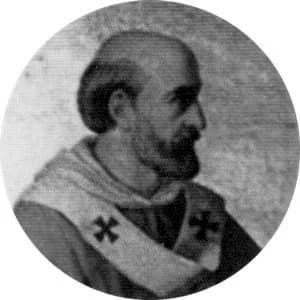
Adrian IV
The only English pope: a clerk's son turned away by his own abbey, who built the church of Norway and faced down an emperor over a stirrup.
Pope no. 1691154-1159
In the whole succession from Peter to the present, one pope was English, and he came from about as far outside the Roman system as it was possible to start. Nicholas Breakspear was born near St Albans to a clerk of modest means, was refused entry to the abbey his own father later joined, and left England as a young man with no prospects to speak of. Thirty years later he was ruling the Latin church and telling the Holy Roman Emperor to hold his horse.
His five years as pope were spent almost entirely on two problems, the Roman commune and Frederick Barbarossa, and he handled the first decisively and the second in a way that guaranteed a twenty-year schism after his death. He also, in a document whose text has been argued over ever since, gave an English king a licence to invade Ireland.
Abbots Langley
He was born around 1100 at Bedmond in the parish of Abbots Langley in Hertfordshire. His father Robert was a clerk who eventually became a monk at St Albans, and the story, which comes from St Albans itself and has the ring of an abbey preserving an awkward memory, is that Nicholas applied to enter and was told to wait and improve himself.
He went to France instead. He studied at Arles, and joined the house of canons regular of Saint-Ruf near Avignon, where he rose to be abbot. His canons found him too strict and twice sent delegations to Rome to complain about him. Eugene III listened to both, decided the fault lay with the canons rather than the abbot, and solved the problem by removing Nicholas upward: about 1149 he was made cardinal bishop of Albano.
The apostle of the North
In 1152 he was sent as legate to Scandinavia, and this is the work by which he should probably be judged. Norway had no metropolitan of its own; its bishops answered to Lund in Denmark, which answered to Hamburg-Bremen in Germany.
Nicholas held a council at Nidaros, the modern Trondheim, and created a Norwegian archbishopric covering Norway, Iceland, Greenland, the Faroes, Orkney, Shetland and the Isle of Man. He established Peter's Pence, set up cathedral chapters, enforced clerical celibacy and free canonical election, and did the same reorganising work in Sweden, where he prepared the ground for the see of Uppsala. The Norwegians remembered him with real affection, which is not the usual response to a papal legate.
He came back in 1154 with a reputation as the most effective administrator in the curia. When Anastasius IV died that December, the cardinals elected him the next day, unanimously and without the usual haggling between factions, which in this period is remarkable enough to be worth stating.
Arnold of Brescia
Rome was in the hands of the commune, and its conscience was Arnold of Brescia, a preacher of genuine austerity who taught that the clergy should hold no property whatever and that the pope had no business governing a city. Four popes had failed to dislodge him.
Arnold's programme was not simply anticlerical. It was the reform argument turned back on the reformers: if the church was corrupted by wealth and lay entanglement, then a pope who ruled a city and taxed it was the worst offender of all. It was uncomfortable precisely because it was coherent, and it drew on the same sources the papacy did.
Adrian did it in a fortnight. In Holy Week 1155, after a cardinal was attacked in the street, he laid an interdict on the city of Rome itself: no masses, no burials, no sacraments except baptism and the confession of the dying, in the season when Rome lived on pilgrims. Nothing like it had been done to Rome before. Within days the Senate capitulated and expelled Arnold, who was seized and handed over, hanged, burnt, and his ashes thrown into the Tiber so that no one could collect relics.
The stirrup and the letter
Frederick Barbarossa came south in June 1155 for his imperial coronation, and the two men met at Sutri. By custom the emperor performed the office of groom for the pope, holding his stirrup and leading his horse a few paces. Frederick declined.
Adrian refused the kiss of peace, and the coronation stalled for a day while the older members of Frederick's court confirmed that the service was customary and implied homage to Peter, not servility to a man. Frederick performed it the following morning, complaining that he did so out of reverence and not obligation, and was crowned. Both had made their point, and both had discovered exactly how far the other would go.
The quarrel became explicit at Besançon in 1157. Adrian's legates read out a letter reminding Frederick of the beneficia the papacy had conferred on him, including the imperial crown. In ordinary curial Latin the word means favours or good offices. In the German chancery it meant a fief, held from a lord, and Rainald of Dassel translated it that way to a hall full of armed princes. Swords came out; the legates left in a hurry. Adrian wrote again explaining that beneficium meant a good deed and nothing more, which settled the incident and convinced nobody.
Laudabiliter
In 1155, at the request of Henry II of England, Adrian is said to have issued the bull Laudabiliter, granting the king lordship over Ireland in order to reform its church, on condition that a penny a year be paid from every household to Rome.
Anagni
The rest was manoeuvre. Beaten in the field by William I of Sicily, Adrian reversed course and made the treaty of Benevento in 1156, recognising the Norman kingdom in exchange for homage and a permanent southern ally. That infuriated Frederick, who regarded Sicily as his. By 1159 Adrian had allied with the Lombard cities against the emperor and was preparing to excommunicate him.
He died at Anagni on 1 September 1159 before he could. He was buried in Saint Peter's in a plain reused antique sarcophagus, which was opened in 1607 and found to contain a small, dark-haired man in black slippers.
The college he left behind split at once between the imperial and Sicilian parties, and the election that followed produced both Alexander III and an antipope. John of Salisbury, who knew him well and liked him, recorded him saying that he had never been more unhappy than since he became pope, and that the papal chair was full of thorns.
Sources
- J. N. D. Kelly and Michael Walsh, The Oxford Dictionary of Popes (2010)
- Brenda Bolton and Anne J. Duggan (eds.), Adrian IV, the English Pope (1154-1159): Studies and Texts (2003)
- I. S. Robinson, The Papacy 1073-1198: Continuity and Innovation (1990)
- Colin Morris, The Papal Monarchy: The Western Church from 1050 to 1250 (1989)
- Eamon Duffy, Saints and Sinners: A History of the Popes (2014)
- Further reading: Wikipedia