Reform and Investiture1046-1198
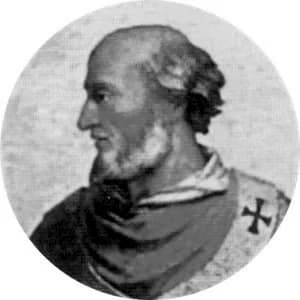
Victor II
The emperor's kinsman and shrewdest bishop, who ended by burying Henry III and governing the empire for his six-year-old heir.
Pope no. 1531055-1057
Gebhard of Eichstätt was the most capable bishop in Germany and the least eager to leave it. Henry III had to negotiate for months before his kinsman would accept Rome, and Gebhard's price was a guarantee that the papacy would recover the lands the empire had absorbed. He was enthroned in April 1055 and immediately proved the shrewdest administrator the reform had yet produced.
He kept Leo IX's programme and Leo IX's men, holding synods at Florence and Lyon against simony and clerical marriage, and sending Hildebrand into France as legate with real power to depose bishops. He also kept Eichstätt, and the chancellorship of Italy along with it, so that the offices of pope and imperial minister sat on one man at once.
Then in October 1056 Henry III died at Bodfeld, aged thirty-nine, with Victor at his bedside. The pope buried him at Speyer, secured the succession of the six-year-old Henry IV, arranged the regency under the empress Agnes, and made peace between the crown and the German princes. For a few months a pope was effectively governing the empire.
He never saw the consequences. Victor died at Arezzo in July 1057 while returning south, and his escort had to fight off an attempt to seize the body for Eichstätt; he was buried at Ravenna instead. With him the imperial guardianship of the reform ended, and the reformers began choosing their own popes.
A full essay on this pope is in preparation. The facts and summary above are complete and sourced.
Sources
- J. N. D. Kelly and Michael Walsh, The Oxford Dictionary of Popes (2010)
- Eamon Duffy, Saints and Sinners: A History of the Popes (2014)
- I. S. Robinson, The Papacy 1073-1198: Continuity and Innovation (1990)
- Further reading: Wikipedia