Reform and Investiture1046-1198
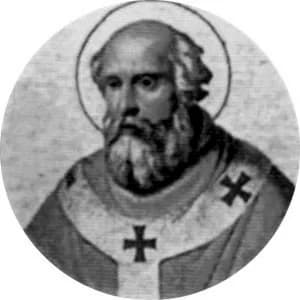
Saint Leo IX
The Alsatian who refused to be pope until Rome had elected him, then crossed the Alps again and again to judge the church in person.
Pope no. 1521049-1054
Henry III had already given Rome two German popes, and both had died within a year. In December 1048 he named a third: his own second cousin Bruno, bishop of Toul, a large, cheerful Alsatian aristocrat who had spent twenty years running a small diocese unusually well. What Bruno did next set the tone for everything after him. He accepted, but said the appointment was worth nothing unless the Roman clergy and people freely elected him too, and he walked into Rome in February 1049 barefoot and in a pilgrim's habit to ask them to.
The gesture was theatre, and it was also a programme. If the papacy was going to tell the church that offices could not be handed out by laymen, it could not hold its own office as a German king's gift. Leo spent the next five years making the claim credible, not from Rome, where he was scarcely present, but from the saddle. He was the first pope in centuries to be seen by ordinary Christians north of the Alps, and he made the papacy a working institution of European government rather than a Roman bishopric with a famous name.
Toul
Bruno was born in Alsace in 1002 into the comital house of Egisheim-Dagsburg, kin to the Salian emperors. He was educated at Toul, served in Conrad II's Italian campaign as a young cleric leading his bishop's contingent, and became bishop of Toul in 1026, at twenty-four. He held the see for over twenty years in a border country that was neither properly French nor properly German, and he ran it as a reformer: he restored monasteries, backed the Lotharingian customs of Gorze against slack observance, and travelled his diocese constantly.
He also learned there what it cost a bishop to be a great man's client. Toul sat on the seam between the empire and France, and Bruno spent two decades keeping a diocese functioning while its neighbours fought over it, feeding his people through the famine of 1032 and rebuilding after fires and raids. That last habit is the key to his pontificate: almost everything Leo did as pope he had already done as a bishop, only on a continental scale.
The story that he went to Rome barefoot on the advice of the young Hildebrand comes from later writers with an interest in making Gregory VII the author of the whole reform, and it should be treated with care. What is certain is the substance. Bruno arrived as a candidate, not as an appointee, and left Worms saying so.
The pilgrim pope
Elected by acclamation in Rome, he was enthroned on 12 February 1049 and held his first synod that April. He then began assembling the men who would run the church for the next fifty years, and he took them from everywhere except Rome: Humbert of Moyenmoutier, a ferocious Lotharingian polemicist, made cardinal bishop of Silva Candida; Frederick of Lorraine, a duke's brother, as chancellor; Hugh the White; and a young Roman monk named Hildebrand, whom he brought back from exile in Germany and who would become Gregory VII.
This was the invention of the curia as a governing body rather than a household. Before Leo, cardinals were the clergy of the Roman churches, men whose horizon was the city and its liturgy. After him they were an international executive drawn from Lorraine, Burgundy, Tuscany and Rome, and the papacy had a staff capable of carrying out decisions taken a thousand miles away. The legate, a man dispatched with the pope's own authority to judge in his absence, became the ordinary instrument of government rather than an occasional embassy.
It cost him Rome. Leo spent perhaps a third of his pontificate in the city, and the Roman nobility, whose grip Sutri had loosened but not broken, was left largely alone. His successors would pay for that.
The reform on the road
In his five years Leo held synods at Rome, Pavia, Reims, Mainz, Vercelli, Siponto, Bari and Mantua. The point was not legislation, which mostly repeated familiar canons against simony and clerical marriage, but enforcement in person, in front of witnesses, on the offender's own ground.
Reims in October 1049 was the demonstration. Leo came to dedicate the new basilica of Saint-Remi, having been asked by the king of France not to come at all, and turned the occasion into a tribunal. He had the relics of Saint Remigius placed on the altar and required every bishop and abbot present to state, in turn, whether he had paid for his office. Some confessed. Some fled the city overnight. The archbishop of Reims was summoned to Rome; the bishop of Langres was deposed. That a pope could arrive in the middle of the French church and put its prelates on oath was a fact nobody had expected, and everyone remembered.
Civitate
The disaster came from the south. Norman adventurers had been carving up Byzantine and Lombard Italy for thirty years, and the complaints reaching Leo, of plundered churches and terrorised peasants, moved him to do what no pope had done in person: he raised an army. It was a poor one, Swabian infantry and Italian levies, and the Byzantine forces meant to join him never arrived.
On 18 June 1053 the Normans met him at Civitate in Apulia and destroyed it. Leo was taken. His captors then knelt to ask his blessing, and kept him at Benevento for nine months in courteous confinement while he negotiated. He came out of it recognising, in effect, that the Normans were in Italy to stay, which his successors would convert into the alliance that guaranteed the reform papacy its independence.
He never recovered. Contemporaries thought the shame killed him as much as the illness, and he seems to have believed it himself: he did penance for the men who had died following his banner, and asked to be carried back to Rome to die near Peter. The lesson his successors drew was the opposite of pacifism. A papacy that intended to defy emperors needed soldiers, and since it could not raise them itself, it would have to hire the men who had just beaten it.
Constantinople
The last act was not really his. Byzantine and Norman friction in Italy had raised old arguments about Greek and Latin usage, and the patriarch Michael Cerularius closed the Latin churches of Constantinople. Leo drafted sharp letters and sent a legation headed by Humbert, the least conciliatory man available.
Leo died in Rome on 19 April 1054, three months before the legates acted. On 16 July, Humbert laid a bull of excommunication on the altar of Hagia Sophia in the name of a pope who had been dead since April; the patriarch anathematised the legates in return.
Leo was buried in Saint Peter's, and miracles were reported at the tomb almost at once. He was canonised within a century. Of the men he had gathered, one became Stephen IX, one wrote the sharpest defence of papal authority of the age, and one became Gregory VII.
Sources
- J. N. D. Kelly and Michael Walsh, The Oxford Dictionary of Popes (2010)
- Eamon Duffy, Saints and Sinners: A History of the Popes (2014)
- Uta-Renate Blumenthal, The Investiture Controversy: Church and Monarchy from the Ninth to the Twelfth Century (1988)
- Colin Morris, The Papal Monarchy: The Western Church from 1050 to 1250 (1989)
- Steven Runciman, The Eastern Schism: A Study of the Papacy and the Eastern Churches during the XIth and XIIth Centuries (1955)
- Further reading: Wikipedia