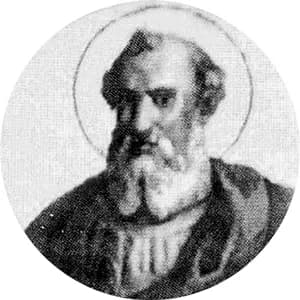
The Age of Persecution99-311
Saint Victor I
The African who wrote in Latin, tried to excommunicate the churches of Asia over the date of Easter, and was told by Irenaeus to calm down.
Pope no. 14c. 189-c. 199
Victor is the first pope with a personality. An African, according to the Liber Pontificalis, and the first bishop of Rome known to have written in Latin rather than Greek, he arrived with the habits of a province where Christianity was already argumentative. Around 190 he demanded that the churches of Asia give up their custom of ending the paschal fast on the fourteenth of Nisan and keep Easter on the Sunday after, as Rome and most of the world did. Synods met from Palestine to Gaul and agreed with him. Polycrates of Ephesus replied with a list of the apostles and martyrs buried in Asia who had kept the fourteenth, and refused to be frightened "by threats." Victor then announced that the Asian churches were cut off from communion.
The reaction was immediate. Irenaeus of Lyon, though he sided with Rome on the date, wrote to Victor reminding him that Anicetus and Polycarp had disagreed on the same point and stayed in communion, that "the disagreement in the fast confirms our agreement in the faith," and that no previous bishop of Rome had thought a custom worth a schism. Other bishops wrote in the same terms, "sharply rebuking Victor," Eusebius says. Whether the excommunication was withdrawn or simply ignored is unclear; the Asian churches kept their date for another century.
Victor was more successful at home. He excommunicated the leather-worker Theodotus for teaching that Jesus was a mere man, and, through Marcia, the Christian concubine of the emperor Commodus, obtained the release of Christians condemned to the Sardinian mines, one of whom, Callixtus, would sit in his chair within twenty years.
A full essay on this pope is in preparation. The facts and summary above are complete and sourced.