The Age of Persecution99-311
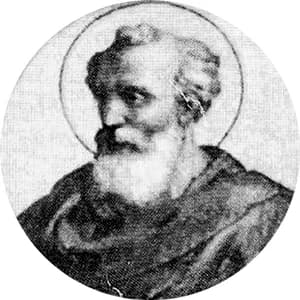
Saint Eleutherius
The deacon who became bishop, received Irenaeus from prisons of Lyon, and closed the list in Against Heresies: twelfth from the apostles.
Pope no. 13c. 175-c. 189
Hegesippus, passing through Rome under Anicetus, noted that "Eleutherus was then a deacon," and by 175 the deacon had the chair. He is the last name on the list Irenaeus drew up a few years later to prove that the Roman church's teaching had come down publicly from the apostles: "now, in the twelfth place from the apostles, Eleutherius holds the episcopate." It is the earliest surviving statement that a living bishop of Rome stood in a line that began with Peter and Paul.
Irenaeus had reason to know him. In 177, when the Christians of Lyon and Vienne were being tortured and killed in the amphitheater, the survivors in prison wrote letters about the new prophecy spreading from Phrygia, the movement later called Montanism, and sent them to Eleutherius by the hand of the presbyter Irenaeus, whom they commended as "zealous for the covenant of Christ." What Eleutherius replied is not recorded. Tertullian says that a bishop of Rome had at first recognized the prophets of Phrygia and then, persuaded by a visitor named Praxeas, withdrawn his letters of peace; if that bishop was Eleutherius, he was the first pope to change his mind about a movement and the first to be blamed for it.
He was buried, the tradition says, near Peter on the Vatican; his feast is 26 May.
A full essay on this pope is in preparation. The facts and summary above are complete and sourced.