Reform and Investiture1046-1198
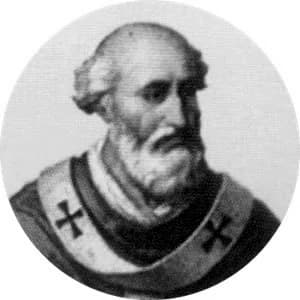
Urban II
The Cluniac who inherited a broken papacy, rebuilt it out of councils and diplomacy, and at Clermont sent armed Europe to Jerusalem.
Pope no. 1591088-1099
Gregory VII left his successors a wreck: an antipope in Saint Peter's, an emperor unbeaten, Rome burnt by the Normans who had come to help, and a reform party reduced to a few castles in Tuscany. Urban II spent eleven years repairing it, and he did so with a temperament exactly opposite to Gregory's. Where Gregory issued ultimatums, Urban negotiated, waited, arranged marriages, bought back city gates, and conceded points of form while keeping the substance. He was the better politician of the two, and he finished most of what Gregory had begun.
He is remembered for one afternoon. At Clermont in November 1095 he preached a sermon calling on the knights of the West to go and recover Jerusalem, and set in motion an enterprise that would occupy Europe for two hundred years, define its relations with Islam and with Byzantium, and give the papacy a form of authority over the laity that no earlier pope had possessed. He died two weeks after Jerusalem fell, without knowing it had.
Châtillon and Cluny
Odo was born in Champagne around 1035 to a family of modest nobility. He studied at Reims, probably under Bruno the future Carthusian, and became archdeacon there. Then, in his thirties, he gave it up and entered Cluny, the greatest and best-run monastery in Europe, where he rose to be grand prior under Abbot Hugh.
Cluny mattered to what he became. It was an institution exempt from every bishop and answerable to Rome alone, with hundreds of dependent houses across France, Spain and Italy, run by a chain of command that actually functioned. Urban had spent years inside the one organisation in the eleventh-century West that was both international and disciplined, and he governed the church like a man who had seen it done.
Gregory VII took him from Cluny around 1080 and made him cardinal bishop of Ostia. He served as legate in Germany, was imprisoned briefly by imperial partisans, and presided at the synod of Quedlinburg in 1085 that condemned Clement III.
A pope without a city
Elected at Terracina in March 1088 by a handful of cardinals, because Rome belonged to the antipope, Urban began with nothing. He recovered ground by patience. He rebuilt the alliance with the Normans of the south and confirmed Roger of Sicily in sweeping powers over the Sicilian church, buying loyalty with concessions. In 1089 he arranged the marriage of Matilda of Tuscany, then in her forties, to the seventeen-year-old Welf of Bavaria, which locked the Alpine passes against Henry IV. In 1093 he encouraged Henry's own son Conrad to rebel and had him crowned king of Italy.
Rome itself came back piece by piece, gate by gate, some of it purchased outright from the captains holding it. He was not in secure possession of the Lateran until 1094, six years into his pontificate.
Through all of it he never once conceded the principle. Lay investiture stayed condemned at every council he held, and Clement III stayed excommunicate. Urban simply declined to make the principle a test he might lose, and waited for the antipope's support to rot, which over eleven years it did.
Piacenza
By March 1095 he was strong enough to hold a council at Piacenza with two hundred bishops and a crowd said to number thirty thousand, too large for any church, so it met in a field. It condemned Berengar's teaching on the Eucharist, dealt with the marriage of the king of France, renewed the ban on lay investiture, and heard the ambassadors of the Byzantine emperor Alexios Komnenos, who asked for western mercenaries to help recover the ground lost to the Seljuks since Manzikert.
Alexios wanted troops for hire. What he eventually received was something else entirely.
Clermont
Urban spent the summer touring France, the first pope to do so in living memory, consecrating altars and holding meetings with the great lords. At Clermont in Auvergne in November he held another council, and on 27 November, in a field outside the city because the crowd would not fit inside, he preached.
That canon was the innovation. Pilgrimage, penance and holy war were all old; fusing them, so that an armed journey became a satisfaction for sin, was new, and it was aimed precisely at the class of men who had most to repent and most capacity for violence. The response was far beyond anything Urban had planned for. He had asked for knights and got whole populations, including the unarmed and destitute crowds who followed Peter the Hermit east and were destroyed in Anatolia, and the bands who began by massacring the Jewish communities of the Rhineland, which he had not called for and could not stop.
The road to Jerusalem
Urban did not go. He appointed Adhemar of Le Puy as legate to lead the expedition spiritually, spent 1096 preaching it across France, and governed the enterprise by letter. The princes' armies reached Constantinople in 1096 and 1097, took Nicaea, survived Dorylaeum, endured the siege of Antioch, and stormed Jerusalem on 15 July 1099 with a slaughter that shocked even sympathetic chroniclers.
The news took weeks to travel. Urban died in Rome on 29 July 1099, a fortnight after the city fell and before any word of it arrived. He was buried in Saint Peter's, and beatified only in 1881.
The consequences ran in every direction at once, and few of them were the ones he intended. Four Latin states were founded in Syria and Palestine. The breach with Constantinople, which the expedition had been meant to heal, widened instead, since Alexios and the crusaders each concluded the other had broken faith. And the papacy acquired a permanent instrument: the power to declare a war holy, to promise remission of sin for fighting it, and to tax and preach across every frontier in Christendom to pay for it.
What Urban built
The crusade obscures the rest, which is a pity, because the rest is why the twelfth-century papacy worked. Urban reorganised the papal household on the Cluniac model into a chancery and a camera, giving Rome a treasury and an archive that could function under pressure. He regularised the college of cardinals as a body with defined duties. He held councils annually and used them as legislature and court together. He gave the reform a settled canonical vocabulary, and he made appeal to Rome an ordinary step in ecclesiastical business rather than an extraordinary one.
Gregory VII had asserted that the pope could command Europe. Urban assembled the machinery that let one actually try.
Sources
- J. N. D. Kelly and Michael Walsh, The Oxford Dictionary of Popes (2010)
- Jonathan Riley-Smith, The First Crusade and the Idea of Crusading (1986)
- Christopher Tyerman, God's War: A New History of the Crusades (2006)
- Colin Morris, The Papal Monarchy: The Western Church from 1050 to 1250 (1989)
- Eamon Duffy, Saints and Sinners: A History of the Popes (2014)
- Further reading: Wikipedia