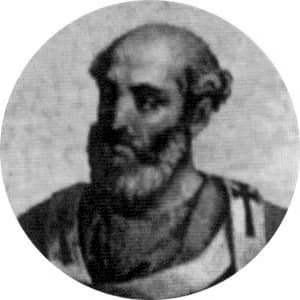
The Byzantine Papacy483-752
Theodore I
A bishop's son from Jerusalem, first of the Greek popes, who deposed two patriarchs and signed one sentence with a pen dipped in the wine.
Pope no. 73642-649
Theodore was born in Jerusalem, the son of a bishop, and came to Rome among the Greek clergy and monks who fled the Persian and then the Arab conquests of the East; Jerusalem fell to the Arabs in 638; he was consecrated on 24 November 642. He was the first of the Greek popes, and he brought to the quarrel over Christ's will a theologian's precision and an exile's anger. He demanded that the patriarch Paul of Constantinople withdraw the Ecthesis; when Paul temporized, Theodore declared him deposed. When Paul's predecessor Pyrrhus, beaten in debate by the monk Maximus the Confessor at Carthage, came to Rome in 645 and recanted, Theodore received him as patriarch; when Pyrrhus went to Ravenna and recanted the recantation, Theodore excommunicated him in Saint Peter's, signing the sentence, the Liber Pontificalis says, with a pen dipped in the consecrated wine.
The emperor Constans II answered in 648 with the Typos, an edict forbidding anyone to discuss whether Christ had one will or two. Theodore refused it and began preparing, with Maximus and the Greek monks of Rome, the council that would condemn it; he died on 14 May 649 before it met, and Martin held it five months later.
He was buried in Saint Peter's. For the next seventy years, with two exceptions, every pope would be a Greek, a Sicilian, or a Syrian, and Rome would conduct its argument with Constantinople in Constantinople's language.
A full essay on this pope is in preparation. The facts and summary above are complete and sourced.
Sources
- J. N. D. Kelly and Michael Walsh, The Oxford Dictionary of Popes (2010)
- Andrew J. Ekonomou, Byzantine Rome and the Greek Popes (2007)
- Jeffrey Richards, The Popes and the Papacy in the Early Middle Ages, 476-752 (1979)
- Raymond Davis (trans.), The Book of Pontiffs (Liber Pontificalis) (2000)
- Further reading: Wikipedia