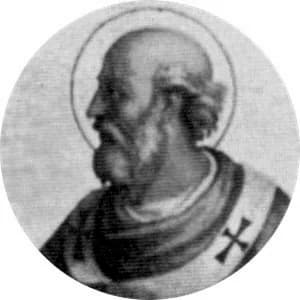
The Byzantine Papacy483-752
Saint Martin I
Consecrated without imperial leave, he condemned the emperor's doctrine, was seized at the altar, tried for treason, and died in the Crimea.
Pope no. 74649-655
Martin is the last pope the church honors as a martyr, and the only one whose martyrdom was carried out by a Christian emperor with a trial, a sentence, and a prison record. He was elected in July 649 and consecrated at once, without waiting for the confirmation from Constantinople that every pope for a century had waited for, because he knew it would not come. Three months later he presided over a council in the Lateran that condemned the doctrine, imposed by two emperors, that Christ had a single will, and condemned the imperial edict that forbade anyone to discuss it. The emperor Constans II sent a governor to arrest him; the governor went over to the pope instead. The next governor did the job. Martin was taken from the Lateran on a couch in June 653, shipped east, held for months, tried for treason before the senate, stripped of his vestments in public, and exiled to Cherson in the Crimea, where he wrote letters home about the price of bread and died in September 655, two years after his arrest, aged perhaps sixty.
The doctrine he died for was vindicated at the council of 681, which said nothing about him. Rome elected his successor while he was alive. His own last letter asked God to keep the faith of the man who had taken his place. What the case established was not that popes could not be tried, since one had been, but that the emperor's power over the bishop of Rome had a limit that Rome would remember, and the Byzantine papacy never fully recovered the deference that Martin had refused to give.
The apocrisiarius
He was born at Todi in Umbria, of a family the sources call noble, and rose through the Roman clergy under the Greek pope Theodore, who sent him to Constantinople as his representative. There he watched the making of the Typos of 648, the edict by which Constans II, a boy emperor advised by the patriarch Paul, tried to end the quarrel over Christ's will by forbidding it: no one was to speak of one will or two, one operation or two, on pain of deposition, exile, or worse. Theodore had already deposed Paul for the doctrine; the Typos was the empire's answer. Martin came home knowing exactly what Rome faced.
Theodore died in May 649 with the council he had planned unheld. The clergy elected Martin and consecrated him on 5 July without a word to the exarch, the first pope since the Pragmatic Sanction to take office without the emperor's leave. Constans never recognized him. In the imperial view, everything Martin did afterward was done by a usurper.
The Lateran Council
The council met in the Lateran basilica on 5 October 649 and sat for five sessions, until the last day of the month. A hundred and five bishops attended, nearly all from Italy, Sicily, and Africa, with Greek monks in the gallery: Maximus the Confessor, the greatest theologian of the age, had come to Rome as a refugee and, most historians now think, drafted the council's acts in Greek before they were rendered into Latin for the bishops to sign. The council condemned Monothelitism in twenty canons, anathematized the patriarchs Sergius, Pyrrhus, and Paul and the Ecthesis and the Typos by name, and affirmed that Christ had two wills and two operations, divine and human, in one person. It did not anathematize the emperors, which was the one restraint Martin showed.
Martin sent the acts to the emperor with a letter, to the churches of the East, and to the bishops of the West, and appointed a vicar for Palestine to organize resistance in the patriarchate of Jerusalem, which the Arabs now held. The letter to Constans asked him to reject the Typos. Constans instead sent the new exarch Olympius to Rome with orders to enforce it, to arrest the pope if the army would obey, and to have him killed if it could be done quietly.
Olympius found Rome united behind its bishop and the army unwilling. He changed sides, declared himself independent of the emperor, held Rome and central Italy for three years, and died of plague in Sicily fighting the Arabs in 652. For those three years Martin governed a Rome that was, for the first time, outside the empire.
The arrest
The new exarch, Theodore Calliopas, arrived in June 653 with the army of Ravenna. Martin, ill with gout, had himself carried to the Lateran basilica and lay on a couch before the altar. Calliopas came on 17 June, read the emperor's order deposing him as an intruder consecrated without leave, and had him taken through a mob that the soldiers held back; the clergy who wanted to follow him were kept in the palace. He was put on a ship at Portus on 19 June and the ship went to Naxos, where it lay for a year while the pope, dysenteric and half-starved, was allowed no visitors. The Roman clergy sent him nothing. He reached Constantinople on 17 September 654, was left lying on the quay all day to be jeered at, and was carried to a prison called Prandearia, where he spent ninety-three days.
The trial
He was tried in December 654 before the senate, not for heresy but for treason: for having supported Olympius's rebellion, for having sent money to the Arabs, for having refused to acknowledge the emperor. He asked to be tried on the Typos and was told the Typos was not the charge. He was carried into court because he could not stand, made to stand anyway, and condemned to death. The sentence was carried out in part. He was taken to a terrace overlooking the crowd, stripped of his vestments to his tunic, his tunic torn open, an iron collar put on his neck, and paraded through the city with the executioner's sword carried before him to the praetorian prison. The dying patriarch Paul, told of it by the emperor, turned his face to the wall and begged him to stop. Constans commuted the sentence to exile.
Martin was held in prison for three more months, in a cell where, he wrote, he could not wash for forty-seven days and was fed as if he were an enemy. In March 655 he was put on a ship for Cherson.
Cherson
Cherson was a Greek town on the southern tip of the Crimea, on the edge of the Khazar steppe, where the empire sent people it wanted forgotten. Two of Martin's letters from there survive. They are about hunger.
Bread is spoken of here but never seen. I have been so weakened by want that I am terrified, and I marvel at the lack of concern of those who once belonged to the church of Saint Peter, who have forgotten a man so entirely that they do not even wish to know whether he is alive.
He asked his friends in Rome for grain, oil, and wine, and heard nothing. He heard instead that the Roman clergy had elected Eugene in August 654, while he sat in prison in Constantinople, under the emperor's pressure and the threat of what had happened to him. His reply was the letter that ends with a prayer for the man who now presided over the Roman church, and a request that his own name be remembered. He died on 16 September 655 and was buried in the church of the Mother of God at Blachernae outside Cherson, where the townspeople began to venerate him almost at once.
The council that vindicated him, the Third Council of Constantinople in 681, anathematized the Monothelite patriarchs and Pope Honorius and never mentioned Martin, because the emperor who summoned it was Constans's son. Rome remembered. His body was said to have been brought home to San Martino ai Monti; his feast entered the calendar; and no emperor ever again arrested a pope in his own basilica and lived to enforce the sentence. The Byzantine papacy went on for another century. Its deference did not.
Sources
- J. N. D. Kelly and Michael Walsh, The Oxford Dictionary of Popes (2010)
- Eamon Duffy, Saints and Sinners: A History of the Popes (2014)
- Richard Price (trans.), The Acts of the Lateran Synod of 649 (2014)
- Bronwen Neil, Seventh-Century Popes and Martyrs: The Political Hagiography of Anastasius Bibliothecarius (2006)
- Andrew J. Ekonomou, Byzantine Rome and the Greek Popes (2007)
- Raymond Davis (trans.), The Book of Pontiffs (Liber Pontificalis) (2000)
- Further reading: Wikipedia