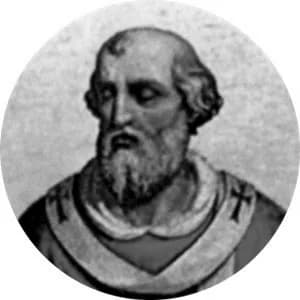
The Carolingian Papacy752-903
Stephen II
He crossed the Alps in winter to ask a Frankish king for an army, and came home with the exarchate: the Papal States begin here.
Pope no. 92752-757
Stephen II reigned five years and spent one of them north of the Alps, and that journey is the reason he matters. Elected in March 752, days after the death of the priest Stephen whose name and election he inherited, he faced a Lombard king, Aistulf, who had taken Ravenna the summer before and now wanted Rome as the next piece of the empire to fall into his hands. The emperor in Constantinople sent letters and an envoy. Stephen wrote to Pepin, king of the Franks for a year with Pope Zachary's blessing, and in the autumn of 753 set out to see him, the first pope to cross the Alps. He met Pepin at Ponthion on 6 January 754, anointed him and his sons at Saint-Denis that July, and named the three of them patricians of the Romans. Pepin marched into Italy twice. In 756 his abbot Fulrad laid the keys of Ravenna and twenty-one other cities on the tomb of Saint Peter, with a deed making them over to the apostle and his successors, and when the emperor's envoys asked for the cities back, Pepin answered that he had fought for Saint Peter and not for the Greeks.
That was the birth of the Papal States, which the popes would govern until 1870, and of the alliance between the papacy and the Frankish dynasty that would produce an emperor within fifty years. Stephen planned neither. He needed a protector against Aistulf and had found that the one he was born under could no longer protect him. He took what the situation offered, and it changed the map of Europe.
The deacon Stephen
He was a Roman of good family, orphaned young with his brother Paul and raised in the Lateran under Gregory III, who made both boys clerics; Zachary ordained him deacon. When Zachary died on 15 March 752 the Romans elected the priest Stephen, who was struck down by apoplexy within days, before he could be consecrated. The deacon Stephen was chosen in his place and consecrated in Saint Peter's on 26 March. The pope-elect left a mark on the numbering: from the sixteenth century some lists counted him, making this Stephen the third of the name and moving every later Stephen up by one; the Annuario Pontificio removed him in 1961, and Cathedra follows that list.
The city he took over was, in law, an outpost of the empire whose exarch had fled Ravenna the year before. In practice it was fed, walled, and defended by its bishop, as it had been since Gregory the Great. Stephen kept the forms: he dated his acts by the emperor's regnal years and sent his election notice east. He also, at once, built hospices for the poor near Saint Peter's, and the Liber Pontificalis credits him with the basilica's first bell tower.
Aistulf
Aistulf sent his demand within weeks: Rome was to accept his lordship and every inhabitant was to pay a gold coin a year. Stephen bought a forty-year peace with gifts in June 752, and Aistulf broke it in four months. Stephen appealed to Constantine V, and the emperor's answer, when it came in 753, was an envoy named John with instructions that the pope should go to Aistulf in person and demand the exarchate back for the empire, with no soldiers behind the demand. Stephen led penitential processions through Rome, barefoot with ashes on his head, the icon of Christ from the Lateran carried in front and the broken treaty tied to a cross. He had also, quietly, sent a pilgrim to Pepin with a letter asking whether the king would receive him, and in the summer of 753 Pepin's envoys, Bishop Chrodegang of Metz and Duke Autchar, arrived in Rome to escort him north.
Across the Alps
He left Rome on 14 October 753 with the imperial envoy, a party of clergy and officials, and no assurance that he would come back. At Pavia Aistulf refused the emperor's demand and tried to keep the pope from going farther, then let him go. The party crossed the Great Saint Bernard in November, rested at the abbey of Saint-Maurice, where Abbot Fulrad of Saint-Denis met them, and reached the royal villa of Ponthion on 6 January 754. Pepin came out with his household to meet the pope, dismounted, prostrated himself, and walked beside Stephen's horse holding the bridle, as a groom does.
Stephen wintered at Saint-Denis and fell gravely ill there. Pepin's brother Carloman, who had left the world for Monte Cassino seven years before, came north at the Lombards' urging to argue against the expedition, and was shut in a monastery at Vienne, where he died. At Quierzy at Easter Pepin and his magnates confirmed the promise in writing, with a list of territories that has not survived and that the popes of the next fifty years interpreted generously. On 28 July 754, in the abbey of Saint-Denis, Stephen anointed Pepin king a second time, together with his queen Bertrada and his sons Charles and Carloman, forbade the Franks under anathema ever to choose a king from another family, and gave all three the title patrician of the Romans, the emperor's own title for his officer in Italy. The Franks now had a dynasty with a pope's seal on it, and the pope had a patrician of his own.
Two campaigns and twenty-two keys
Pepin marched in August 754, beat Aistulf at the passes above Susa, and besieged him in Pavia until he swore to hand over Ravenna and the cities. Then Pepin went home, and Aistulf did nothing of the kind. On 1 January 756 the Lombard army was outside Rome, and it stayed into the spring, burning the farms, digging up the catacombs for relics, and shooting arrows over the walls. The letters Stephen sent north in those weeks survive in the collection Charlemagne later ordered kept, the Codex Carolinus, and one of them is written in the person of Saint Peter himself, who tells Pepin that he stands at the gate of heaven and will remember who came to his city's aid and who did not.
Pepin came again in the spring. Aistulf surrendered again, this time with a third of his treasure and Frankish and papal officers at his side. Fulrad went from city to city with them, took the keys and hostages from each, and laid the keys and Pepin's deed of gift on the confessio of Saint Peter's: Ravenna, Rimini, Pesaro, Fano, Cesena, Senigallia, Iesi, Forlì, Forlimpopoli, Urbino, Gubbio, Comacchio, Narni, and the rest, twenty-two in all by the Liber Pontificalis's count. On the way south the emperor's envoys had caught up with Pepin and offered him money to return the exarchate to its rightful sovereign.
It was for no man's favour that he had committed himself to battle, but for the love of Saint Peter and the pardon of his sins; and no amount of treasure would persuade him to take back what he had once offered to Saint Peter.
Aistulf died in a hunting fall that December. Stephen backed the duke Desiderius for the succession over the former king Ratchis, in exchange for a promise of more cities, of which a few were delivered. It was the last bargain of his life.
The republic of Saint Peter
What Stephen governed after 756 was new and had no name that fit it. His letters call it the republic of the Romans and its people the peculiar people of Saint Peter; he still dated by the emperor's years; the Franks called him the head of the Roman church and left the rest undefined. He was a landlord on a new scale, with the revenues of the Ravenna territory added to the church's estates, and a ruler whose army had gone home. He organized the new territory through the Lateran offices, sent his brother Paul as envoy to Pavia, and died on 26 April 757, five years and a month after his consecration. He was buried in Saint Peter's, and Paul was elected in his place.
Two things had happened that no one at Ponthion had proposed. A king outside the empire had been anointed by a pope and had taken a title from him, which within half a century would make an emperor. And a bishop had become the sovereign of a state, with a Frankish guarantee that would be renewed, reinterpreted, and fought over for as long as there were Frankish kings. Stephen's successors would spend the era learning what he had signed.
Sources
- J. N. D. Kelly and Michael Walsh, The Oxford Dictionary of Popes (2010)
- Eamon Duffy, Saints and Sinners: A History of the Popes (2014)
- Thomas F. X. Noble, The Republic of St. Peter: The Birth of the Papal State, 680-825 (1984)
- Raymond Davis (trans.), The Lives of the Eighth-Century Popes (Liber Pontificalis) (1992)
- Rosamond McKitterick, Dorine van Espelo, Richard Pollard, and Richard Price (trans.), Codex Epistolaris Carolinus: Letters from the Popes to the Frankish Rulers, 739-791 (2021)
- Bernhard Walter Scholz (trans.), Carolingian Chronicles: Royal Frankish Annals and Nithard's Histories (1970)
- Further reading: Wikipedia