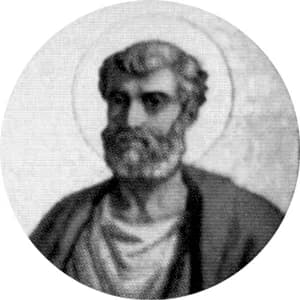
The Age of Persecution99-311
Saint Stephen I
The first pope known to claim Peter's chair against other bishops: he fought Cyprian over rebaptism, won the argument, and lost his allies.
Pope no. 23254-257
Stephen reigned for three years and three months and spent most of them in a quarrel. He is the first bishop of Rome whose policy can be followed month by month, because the man on the other side of it, Cyprian of Carthage, kept copies of everything and his secretaries preserved them. What the letters show is a pope who behaved as no predecessor had: reinstating a deposed bishop in Spain, being asked to depose one in Gaul, refusing to receive envoys from Africa, threatening to break with the churches of Asia, and, when pressed for his authority, citing the chair of Peter and the words of Christ at Caesarea Philippi. His opponents thought him arrogant, ignorant, and a friend of heretics. The church, in the long run, adopted his ruling and forgot his manner.
The ruling was that baptism, once validly given in the name of the Trinity, could not be repeated, even if the man who gave it was a heretic. It seems a technical point. It was in fact the question of where the church's boundaries lay, and whether the sacraments belonged to the institution or to the holiness of the people who administered them. Augustine would build his answer to the Donatists on Stephen's side of it a century and a half later, and the Latin church has held it ever since.
Rome after Decius
Stephen was a Roman, the son of Jovius according to the Liber Pontificalis, and archdeacon of the Roman church under Lucius, which made him the obvious successor when Lucius died in March 254. He was elected on 12 May. The church he inherited was still sorting through the wreckage of the Decian persecution four years earlier: thousands of Christians had sacrificed or bought certificates saying they had, the presbyter Novatian had broken away rather than readmit them and now led a rival church with its own bishops in several provinces, and Cornelius and Lucius had both died in exile holding the line that the fallen could return after penance. Cyprian, who had spent the persecution in hiding and been criticized for it, was the dominant bishop of the West, and the alliance between Carthage and Rome had held the church together. Stephen inherited that alliance and, within two years, broke it.
The appeals
The first cases came to him from outside Italy, and they show how far the habit of looking to Rome had spread. Two Spanish bishops, Basilides of León and Martial of Mérida, had bought certificates of sacrifice under Decius and been deposed by their own people; Basilides went to Rome, told Stephen his story, and came home reinstated. The Spanish congregations appealed to Carthage, and a council of thirty-seven African bishops backed the deposition, excusing Stephen on the ground that "being far away and unaware of the truth" he had been deceived. The African letter did not deny that Stephen could act; it complained that he had acted badly.
The second case ran the other way. Marcian, bishop of Arles, had sided with Novatian and was refusing reconciliation to the dying. Faustinus of Lyon wrote to Cyprian, who wrote to Stephen urging him to "send letters to the province and the people of Arles by which Marcian may be excommunicated and another put in his place." Cyprian assumed that the bishop of Rome could remove a bishop in Gaul; the request is the earliest evidence that anyone thought so. Whether Stephen did it is unknown.
Water and tradition
The break came over water. The churches of Africa and Asia Minor held, on the authority of their own councils, that baptism given outside the church was no baptism, so that a convert from a heretical or schismatic group had to be baptized on entry; Rome, Alexandria, and Palestine held that the rite could not be repeated, and received such converts by the laying on of hands in penance. When Novatianist converts began arriving in numbers the difference became urgent. Cyprian summoned councils at Carthage in 255 and 256, the last with eighty-seven bishops, which unanimously reaffirmed rebaptism, and sent the decisions to Rome.
Stephen's reply survives only in the sentences Cyprian quoted in order to refute them, and one of them became famous.
Let nothing be innovated except what has been handed down.
Rome had always received heretics by the laying on of hands, Stephen wrote, and the Africans were to do the same; the baptism of heretics, whoever they were, was to be honored. Then he refused to see the African envoys, forbade the Roman Christians to give them shelter, and, according to a furious letter from Firmilian of Caesarea in Cappadocia, called Cyprian "a false Christ, a false apostle, a deceitful worker." He also wrote to the bishops of Asia Minor that he would no longer be in communion with them. Dionysius of Alexandria, who agreed with Stephen on the substance, wrote to him begging for peace and reminding him that the churches of Syria and Arabia, which Rome was accustomed to help, were watching.
On this rock
Firmilian's letter, which Cyprian translated and kept, records the argument Stephen had used. The bishop of Rome, Firmilian wrote with contempt, "boasts of the place of his episcopate and contends that he holds the succession from Peter, on whom the foundations of the church were laid," and yet by admitting heretics' baptism he was introducing "many other rocks" and building "many new churches." It is the earliest surviving evidence that a pope had invoked Matthew 16, "on this rock I will build my church," to claim authority over bishops outside Italy. The reaction was not deference. Firmilian called him worse than Judas, and Cyprian, in the council of 256, declared that "none of us sets himself up as a bishop of bishops or compels his colleagues by tyrannical terror."
Death and afterlife
The quarrel was ended by Valerian. His first edict, in August 257, ordered the clergy to sacrifice, and Stephen died on 2 August, the day before the calendar month in which the persecution began, of causes nobody recorded. Cyprian was arrested at the end of August and beheaded the following September. Sixtus II, Stephen's successor, made peace with Africa within weeks without conceding the point.
The ruling outlived everyone. The Council of Arles in 314, the first Western council under a Christian emperor, adopted Rome's practice; Nicaea in 325 required rebaptism only for the followers of Paul of Samosata, whose rite had not used the Trinity; and Augustine, fighting the Donatists of Africa with their Cyprianic theology of the pure church, made Stephen's principle the foundation of Western sacramental doctrine: the sacrament belongs to Christ, not to the minister. What did not outlive him was the manner. The bishops who had rebuked Victor for the Easter quarrel sixty years earlier rebuked Stephen in the same terms, and the church remembered him, when it remembered him at all, as the pope who had been right in a way that nobody could stand. That combination would become familiar.
Sources
- J. N. D. Kelly and Michael Walsh, The Oxford Dictionary of Popes (2010)
- Eamon Duffy, Saints and Sinners: A History of the Popes (2014)
- Cyprian of Carthage, The Letters of Cyprian of Carthage (258) · link
- Eusebius of Caesarea, The Ecclesiastical History (325) · link
- Raymond Davis (trans.), The Book of Pontiffs (Liber Pontificalis) (2000)
- Further reading: Wikipedia