The Age of Revolution1799-1958
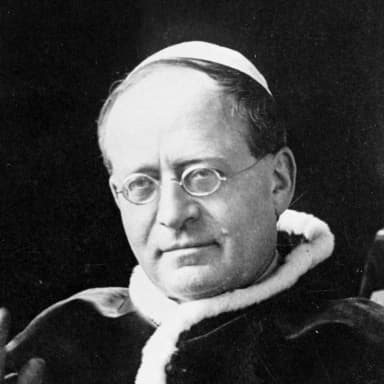
Pius XI
The mountaineering librarian who founded Vatican City, made peace with Mussolini, and then denounced Fascist and Nazi idolatry.
Pope no. 2591922-1939
Achille Ratti was a scholar-librarian who had spent thirty years among manuscripts at the Ambrosiana in Milan and the Vatican Library, and a serious alpinist. Sent to Poland as nuncio in 1919, he stayed in Warsaw while the Red Army closed in during the summer of 1920, and the stubbornness impressed Rome: archbishop of Milan and cardinal in June 1921, pope on 6 February 1922 after fourteen ballots. His first act announced the reign. He gave his blessing from the external loggia of Saint Peter's, facing the city, which no pope had done since 1870.
The gesture pointed to the Lateran Treaty of 11 February 1929, signed with Mussolini's Italy: the pope recognized the Italian state, Italy recognized the sovereign State of Vatican City, forty-four hectares that ended sixty years of self-imprisonment, and a concordat made Catholicism the religion of the nation. Pius XI had traded the Papal States for a guarantee of independence, and he spent the next decade learning what dealing with a dictator cost. Non abbiamo bisogno (1931) defended Catholic Action against Fascist violence; Quadragesimo anno the same year updated Rerum novarum and coined the principle of subsidiarity; Casti connubii (1930) fixed the church's teaching on marriage and contraception for the century. With Germany he signed the Reichskonkordat of 1933 and then watched it violated, until in March 1937 the encyclical Mit brennender Sorge, written in German and smuggled in to be read from every pulpit on Palm Sunday, condemned the Nazi cult of race and state. Divini Redemptoris, five days later, condemned atheistic communism. He founded Vatican Radio with Marconi in 1931, consecrated six Chinese bishops with his own hands in 1926, and told Belgian pilgrims in 1938 that "spiritually, we are all Semites."
He died on 10 February 1939, the night before he was to deliver a speech to Italy's bishops that his aides expected to break with Fascism. It was never given.
A full essay on this pope is in preparation. The facts and summary above are complete and sourced.
Sources
- J. N. D. Kelly and Michael Walsh, The Oxford Dictionary of Popes (2010)
- Eamon Duffy, Saints and Sinners: A History of the Popes (2014)
- David I. Kertzer, The Pope and Mussolini: The Secret History of Pius XI and the Rise of Fascism in Europe (2014)
- Further reading: Wikipedia