The Age of Revolution1799-1958
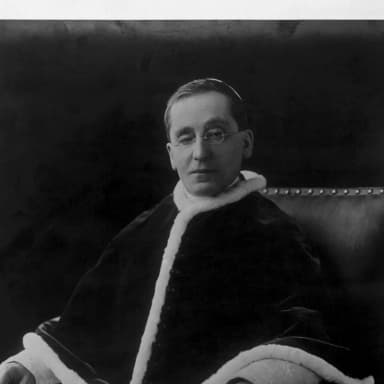
Benedict XV
The Genoese diplomat who called the Great War the suicide of Europe, was ignored by both sides, and spent the Vatican dry on its victims.
Pope no. 2581914-1922
Giacomo della Chiesa was a Genoese aristocrat, a career diplomat trained under Cardinal Rampolla, and a tiny, stooped man. Shunted to the archbishopric of Bologna in 1907 by a curia that distrusted his politics, he received the cardinal's hat only in May 1914 and the papacy three months later, on 3 September, thirty-three days into the First World War. The cardinals had chosen a diplomat for a diplomatic catastrophe, and he spent his reign discovering how little a pope could do about one.
He refused to bless either side's guns. His first encyclical called the war "the suicide of civilized Europe," and his Peace Note of 1 August 1917, proposing an end to what he called "useless slaughter" through disarmament, arbitration, and the restoration of occupied territories, was rejected by every belligerent and denounced as pro-German in Paris and pro-French in Berlin. Italy's allies secretly promised to keep him out of the peace conference, and did. What he could do, he did lavishly: the Vatican ran a bureau that traced missing soldiers and passed some 600,000 messages between prisoners and their families, negotiated the exchange of wounded prisoners and their convalescence in Switzerland, and poured its reserves into relief for orphans and the starving of occupied Europe until it was nearly bankrupt. Muslim Turkey raised a statue to him in Istanbul in 1921 as "the benefactor of all peoples, regardless of nationality or religion."
Inside the church he ended the Modernist witch hunt, promulgated the Code of Canon Law on 27 May 1917, created a congregation for the Eastern churches, and in Maximum illud (1919) ordered the missions to build native clergy and shed European nationalism, the charter of the twentieth-century missionary church. He restored diplomatic relations with France, canonized Joan of Arc, and died of pneumonia on 22 January 1922, at sixty-seven, largely forgotten by the world he had tried to stop from killing itself.
A full essay on this pope is in preparation. The facts and summary above are complete and sourced.
Sources
- J. N. D. Kelly and Michael Walsh, The Oxford Dictionary of Popes (2010)
- Eamon Duffy, Saints and Sinners: A History of the Popes (2014)
- John F. Pollard, The Unknown Pope: Benedict XV (1914-1922) and the Pursuit of Peace (1999)
- Further reading: Wikipedia