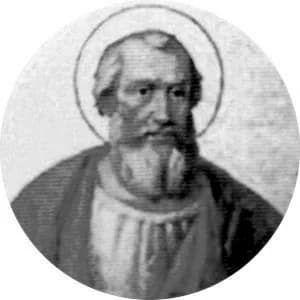
The Imperial Church311-483
Saint Mark
Nine months in 336: two churches founded, the bishop of Ostia given the pallium, and a tomb on the Via Ardeatina dated to the day.
Pope no. 34336
Mark was elected on 18 January 336, eighteen days after Sylvester's death, and died on 7 October of the same year. The Liber Pontificalis makes him a Roman, the son of Priscus, and a letter of Constantine's names a presbyter Mark among the senior Roman clergy in 313, perhaps the same man; if so, he was old when elected.
Two churches are his. In the Campus Martius, near the foot of the Capitol, he founded the titulus Marci, which survives as San Marco under the walls of the Palazzo Venezia, rebuilt many times but still on his ground. And on the Via Ardeatina, above the catacomb of Balbina, he built a cemetery basilica where he was buried; the emperor endowed both with land, and the Liber Pontificalis lists the farms. The same source says he granted the bishop of Ostia, who consecrated each new bishop of Rome, the right to wear the pallium, the first mention of the woolen band that would become the badge of every archbishop in the Latin church.
Nothing else is recorded. His reign fell in the last year of Constantine's life, while Athanasius sat in exile at Trier and the emperor prepared the war with Persia he would not live to fight; whether Mark took any position on the exiled bishop of Alexandria is unknown. The see stayed empty for four months after him, an unusual gap in a settled church, and the next pope, Julius, would spend fifteen years on the question Mark had not touched.
A full essay on this pope is in preparation. The facts and summary above are complete and sourced.
Sources
- J. N. D. Kelly and Michael Walsh, The Oxford Dictionary of Popes (2010)
- Raymond Davis (trans.), The Book of Pontiffs (Liber Pontificalis) (2000)
- Eamon Duffy, Saints and Sinners: A History of the Popes (2014)
- Further reading: Wikipedia