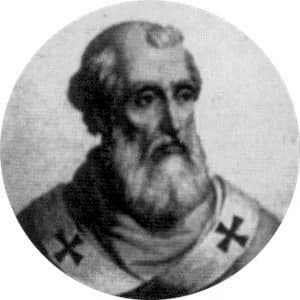
The Carolingian Papacy752-903
Marinus I
The first bishop of another see to become pope, three times a legate to Constantinople, and the man who brought Formosus back.
Pope no. 108882-884
Marinus was born at Gallese, north of Rome, son of a priest named Palumbus, and entered the Roman clergy at twelve; Leo IV made him subdeacon, and for the next three popes he was the man sent east. Nicholas I sent him to Constantinople in 866, and the Greeks turned him back at the frontier; Adrian II sent him as one of the three legates who presided at the council of 869 and 870, where he refused to seat Photius's bishops; John VIII sent him a third time and then made him bishop of Caere and treasurer of the Roman church. When John was killed on 16 December 882 Marinus was elected and consecrated at once, and no one waited for the emperor.
His first act reversed John's last quarrel: he lifted the sentence on Formosus, recalled him from exile, and restored him to Porto, and he pardoned the others condemned with him in 876. He renewed the excommunication of Photius, though Constantinople took no notice. He met Charles the Fat at Nonantola in 883. And he had a friend in England: at the request of King Alfred he freed the English quarter around Saint Peter's from tax and sent the king a fragment of the True Cross, a gift Asser recorded in his life of Alfred. He died on 15 May 884 after seventeen months and was buried in Saint Peter's. Later scribes, misreading his name, listed him as Martin II, and the error stuck long enough that the next Martin, elected in 1281, numbered himself the fourth.
A full essay on this pope is in preparation. The facts and summary above are complete and sourced.
Sources
- J. N. D. Kelly and Michael Walsh, The Oxford Dictionary of Popes (2010)
- Eamon Duffy, Saints and Sinners: A History of the Popes (2014)
- Peter Llewellyn, Rome in the Dark Ages (1971)
- Simon Keynes and Michael Lapidge (trans.), Alfred the Great: Asser's Life of King Alfred and Other Contemporary Sources (1983)
- Further reading: Wikipedia