The Carolingian Papacy752-903
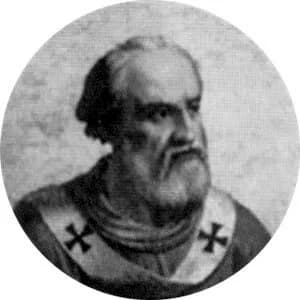
John VIII
He built a fleet against the Saracens, crowned two emperors who could not save him, blessed the Slavonic Mass, and was murdered.
Pope no. 107872-882
John VIII was archdeacon of Rome for twenty years before he was pope for ten, and both jobs were the same: keeping a city alive on a frontier. The Saracens who had sacked Saint Peter's in 846 now held Bari and camped on the Garigliano, and they raided the Campagna every summer. The emperor Louis II died in 875 with no son. John crowned Charles the Bald that Christmas in exchange for a promise of help, and Charles died two years later on his way home from failing to keep it. So John did it himself. He built a fleet of galleys and commanded it in person, beat a Saracen squadron off Cape Circeo in 877, excommunicated the bishop of Naples and the coastal dukes who paid the raiders to be left alone, and, when nothing else held, paid them himself, twenty-five thousand silver coins a year. He walled Saint Paul's Outside the Walls and named the enclosure Johannipolis. In 878 the duke of Spoleto shut him in Saint Peter's for a month; he escaped by sea to Provence and came home without a champion. He crowned Charles the Fat in 881 and got nothing. On 16 December 882 he died in the Lateran, by poison and then a hammer if the Annals of Fulda are right, the first pope murdered in office.
He also, in a year when everything else was going wrong, settled the question of the Slavonic liturgy. Methodius, archbishop of the Moravians, was summoned to Rome in 880, examined, and sent back with a letter that praised the alphabet Cyril had made and allowed the Mass to be sung in Slavonic, provided the Gospel was read first in Latin. It is the one decision of his reign that a whole civilization remembers.
The archdeacon
John was a Roman, son of a man named Gundo, and he had been archdeacon of the Roman church since the 850s, the officer who ran its finances and its charities and stood next in line. He was Nicholas I's chief agent and Adrian II's, and when Adrian died in December 872 he was elected and consecrated on the same day, 14 December, at something over fifty. The register of his letters, the only papal register of the century to survive in bulk, begins soon after, and it shows a man who wrote to everyone: emperors and dukes, the bishops of Naples and Capua, the Byzantine court, the Moravians, the English, in a Latin that did not waste words.
The situation he inherited was military. Louis II had taken Bari from the Saracens in 871 with Byzantine help, only to be seized and imprisoned by the duke of Benevento; Adrian II had absolved him of the oath extorted in prison and crowned him a second time, and by 873 raiding bands from Sicily and Africa were again working the coast from the Garigliano to the Tiber. John's first care was to keep the only emperor who would fight in the field. Louis died in August 875 with no son.
Whom we chose
Two claimants wanted the empire: Louis's uncle Charles the Bald, king of the West Franks, and his cousins, the sons of Louis the German. John chose Charles, who came to Rome and was crowned on Christmas Day 875, seventy-five years to the day after his grandfather. The pope's letters afterward call Charles the emperor whom we chose, the first time a pope had said in so many words that the empire was his to give. Charles paid in promises: the papal territories confirmed, papal elections free, the duchy of Spoleto restrained, an army against the Saracens. He went home, came back in 877 to keep the promise, lost his nerve when his nephew Carloman entered Italy, and died crossing the Alps on the retreat.
The fleet
In the meantime John fought. His letters of 876 describe the Campagna as a desert, farms burned, monasteries emptied, the roads to Rome unsafe, the raiders camped at the mouth of the Garigliano, where they would stay for forty years. He tried three things. He bound the cities of the coast, Naples, Amalfi, Gaeta, Salerno, and Capua, by oath at Traetto in 877 not to make terms with the Saracens, and paid Amalfi ten thousand silver mancuses to patrol the sea, which Amalfi took and did not do. He excommunicated the rulers who traded with the enemy, above all Athanasius, the bishop who had made himself duke of Naples by blinding his own brother and kept a Saracen garrison in the city. And he built ships. In 877 the pope put to sea with a squadron of galleys he had equipped himself, met a Saracen fleet off Cape Circeo, and took eighteen ships and freed six hundred captives, by his own account. It was the first battle a pope had commanded.
It bought a season. Within a year he was paying the raiders twenty-five thousand mancuses a year not to come, and asking Constantinople for a fleet. He also built. Saint Paul's Outside the Walls, sacked in 846, had no wall, and Leo IV had walled only the Vatican; John enclosed the basilica and its monastery in a circuit of their own and named it Johannipolis, as Leo had named the Leonine City.
Troyes
After Charles the Bald's death the Italian magnates chose between Carloman of Bavaria and no one, and Lambert, duke of Spoleto, with Adalbert of Tuscany, marched into Rome in the spring of 878, made the Romans swear to Carloman, and kept the pope shut in Saint Peter's for thirty days while their men plundered. John excommunicated them, got out by sea, and sailed to Provence to find an emperor. He held a synod at Troyes in August 878 with Louis the Stammerer, Charles's son, who was ill and could give him nothing but assent to the anathema on Lambert; he adopted Boso, the duke of Provence, as his son and hoped to make him king of Italy, and Boso made himself king of Provence instead. John came home in the winter with nothing. He tried Charles the Fat, the last of Louis the German's sons, crowned him emperor at Rome in February 881, and got nothing again; the letters of 882 to Charles are those of a man who knows he is asking in vain.
The Slavonic Mass
The one success was in the north. Methodius, whom Adrian II had made archbishop for the Slavs in 869, had been seized by the Bavarian bishops, who regarded Pannonia as theirs, and held in a Swabian monastery for three years; John, who learned of it in 873, ordered him freed and restored, and at first told him to stop celebrating Mass in Slavonic. Six years later Methodius's enemies, led by a Swabian priest named Wiching, accused him at Rome of heresy and disobedience. Methodius came in 880, was examined, and was cleared, and the letter John sent back to Prince Svatopluk that June, Industriae tuae, is the charter of the Slavonic church: the letters Constantine the philosopher had invented were praised, the Mass in Slavonic was approved, and only the Gospel was to be read first in Latin. John also, unfortunately, made Wiching bishop of Nitra. Methodius died in 885, and the next pope banned what John had blessed; but the Slavonic liturgy survived in Bulgaria and became the liturgy of the Orthodox Slavs, and John's letter is why the Roman church could say, a thousand years later, that it had blessed it first.
The same need for allies shaped his policy toward Constantinople. Photius, restored as patriarch in 877, was recognized by John at the council of 879, in exchange for promises about Bulgaria that were not kept; the Greek text of John's letters was doctored at the council, and John protested and did nothing more, because he wanted Byzantine ships.
The hammer
Formosus of Porto, Nicholas's missionary to Bulgaria and the ablest bishop in Italy, had been condemned by John in 876 for conspiring with the pope's enemies and had fled Rome; degraded at Troyes in 878 and made to swear never to return, he was living in exile when John died, and would be pope within a decade. John's last year was spent excommunicating Athanasius of Naples again and writing to Charles the Fat. On 16 December 882 he died in the Lateran.
He was buried in Saint Peter's. Frankish writers of the next generation remembered a pope who had given way to Photius and paid the Saracens, and a hypothesis going back to Baronius holds that the legend of Pope Joan began as a sneer at his weakness. The register tells a different story: a pope who fought a war with the resources of one city, made two emperors who failed him, and blessed a liturgy that outlived every empire in the reckoning. Rome's frontier had not held because Rome could not hold it alone, and John VIII had been the first to prove it at sea.
Sources
- J. N. D. Kelly and Michael Walsh, The Oxford Dictionary of Popes (2010)
- Eamon Duffy, Saints and Sinners: A History of the Popes (2014)
- Peter Llewellyn, Rome in the Dark Ages (1971)
- Barbara M. Kreutz, Before the Normans: Southern Italy in the Ninth and Tenth Centuries (1991)
- Francis Dvornik, Byzantine Missions Among the Slavs: SS. Constantine-Cyril and Methodius (1970)
- Timothy Reuter (trans.), The Annals of Fulda (1992)
- Further reading: Wikipedia