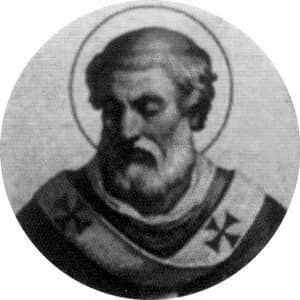
The Carolingian Papacy752-903
Saint Leo III
Beaten in the street, judged by no one, he set a crown on Charlemagne's head on Christmas Day 800 and made an emperor.
Pope no. 96795-816
Leo III was pope for twenty years and is remembered for one morning. On Christmas Day 800, as Charlemagne rose from prayer at the tomb of Saint Peter, Leo set a crown on his head and the Romans in the basilica acclaimed him emperor, the first in the West since 476. Everything else in the reign happened on the way to that morning or because of it. He had been elected the day after Adrian I died, a Roman priest of no family in a church the Roman nobles thought belonged to them, and he had at once sent Charlemagne the keys of Saint Peter's confessio and the banner of the city, which told the Frankish king who his protector was and told the nobles the same. In April 799 they tried to blind him and cut out his tongue in the street. He escaped over the Alps to Charlemagne's camp at Paderborn, came back under Frankish escort, and in December 800, since no one could judge the pope, swore an oath in Saint Peter's that he was innocent of everything his attackers alleged. Two days later he made the emperor.
Whether Charlemagne wanted the crown, or wanted it that way, was disputed by his own biographer. Whether Leo meant the gesture to make emperors the gift of popes, as later popes would say he had, is doubtful; he needed a protector who could not be argued with, and a Roman emperor was the strongest title he had to give. In the sixteen years left to him he refused to change the Creed to please that emperor's theologians, outlived him, and survived one more conspiracy in a city that never accepted him.
The priest from the vestiary
He was born in Rome, the son of Atyuppius and Elizabeth according to the Liber Pontificalis, which is careful to say nothing of their rank; he was raised in the Lateran from childhood, served in the vestiarium, the treasury of vestments and plate, and was cardinal priest of Santa Susanna when Adrian I died on 25 December 795. He was elected the next day and consecrated the day after, a speed that looks like a decision to forestall Adrian's relatives. His first letter went north with the keys of the confessio and the banner of Rome, asking Charlemagne to send an envoy to receive the Romans' oath of fidelity. The reply, drafted by Alcuin, set out the partnership as the Franks understood it: the king's task was to defend the church from without and strengthen the faith within; the pope's, like Moses on the hill, was to raise his hands and pray for the king's army.
The feast of Saint Mark
On 25 April 799, riding from the Lateran to the procession of the greater litany at San Lorenzo in Lucina, Leo was set upon by armed men led by Paschalis, Adrian's nephew and head of the papal notaries, and Campulus, the treasurer, nobles who had run the Lateran under the last pope. They pulled him from his horse, beat him, tried to gouge out his eyes and cut out his tongue, and left him in the street before dragging him to the monastery of Saint Erasmus on the Caelian. He recovered his sight and speech, which the Liber Pontificalis calls a miracle and Frankish writers doubted, was let down the wall by night with the help of his chamberlain, and was taken by the duke of Spoleto to safety and then across the Alps to Paderborn in Saxony, where Charlemagne was campaigning.
Christmas
Charlemagne reached Rome on 24 November 800, was received on the steps of Saint Peter's, and held a synod in the basilica on 1 December at which the Frankish bishops declared they did not dare to judge the apostolic see. On 23 December Leo mounted the ambo with the gospels in his hands and swore, of his own will and under no compulsion, that he had done none of the things alleged against him. The same day, the Frankish annals record, envoys arrived from Jerusalem with the keys of the Holy Sepulchre and the banner of the city. On Christmas Day, at Mass, as the king rose from prayer before the confessio, the pope put a crown on his head.
Pope Leo placed a crown on his head, and all the Roman people acclaimed him: To Charles Augustus, crowned by God, great and peaceful emperor of the Romans, life and victory!
Leo then knelt before the new emperor in the adoratio the popes had given the emperors in Constantinople. Charlemagne's biographer Einhard wrote years later that the king so disliked the titles of emperor and Augustus that he would not have entered the church that day, though it was a great feast, had he known what the pope intended.
Whatever Charlemagne intended, the coronation settled Leo's case. The conspirators were now tried by the emperor as men who had attacked his patrician's lord, sentenced to death, and, at Leo's plea, exiled instead.
The shields
The next quarrel was over a word. Frankish monks on the Mount of Olives, singing the Creed as they had learned it at Charlemagne's court, were accused by their Greek neighbors of heresy for saying that the Holy Spirit proceeds from the Father "and the Son," the Filioque, which churches in the Latin West had been adding to the Creed for two centuries and Rome had not. The monks wrote to Leo; Charlemagne held a council at Aachen in November 809 that endorsed the addition; and in 810 his envoys came to Rome to have the pope approve it. Leo agreed with the doctrine and refused the addition. What a general council had fixed, he told them, no one had the right to alter, and the Franks would do well to stop singing it, as Rome did not. To make the point permanent he had the Creed engraved, in Greek and in Latin and without the clause, on two silver shields, and hung them beside the confessio of Saint Peter.
Rome held out until 1014, when a German emperor asked for the clause and got it. The rest of Leo's reign was spent in building, largely on the emperor's money: the triclinium of the Lateran, a banqueting hall whose apse mosaic showed Saint Peter handing the pallium to Leo and the banner of Rome to Charlemagne, and which survives in a rebuilt form across from the Scala Santa; a second great hall at Saint Peter's; repairs after the earthquake of 801; and gifts of plate and silk to the churches that fill pages of the Liber Pontificalis. In 812 the eastern emperor Michael I at last recognized Charlemagne as emperor, though not as emperor of the Romans.
After Charlemagne
Charlemagne died in January 814, and within a year the Roman nobles tried again. A conspiracy to kill Leo was discovered in 815, and he had the leaders executed without reference to the new emperor, Louis the Pious, who sent his nephew Bernard, king of Italy, to investigate. In 816, with the pope dying, the Romans rose and burned the farms he had established in the Campagna to feed the city, and Bernard's officers had to put the rising down. Leo died on 12 June 816 and was buried in Saint Peter's. The Roman nobility never accepted him, and the Frankish court thought him a pope who had needed too much rescuing.
He was enrolled among the saints in 1673, on the strength of the miracle of Saint Mark's day and the coronation, and his feast is 12 June. The coronation is the real monument. It gave the West an emperor whose title came, in form at least, from a pope's hands, and when the popes of the eleventh century began to say that emperors were made and unmade at Rome, the precedent they cited was the morning Leo III set a crown on a kneeling king.
Sources
- J. N. D. Kelly and Michael Walsh, The Oxford Dictionary of Popes (2010)
- Eamon Duffy, Saints and Sinners: A History of the Popes (2014)
- Thomas F. X. Noble, The Republic of St. Peter: The Birth of the Papal State, 680-825 (1984)
- Raymond Davis (trans.), The Lives of the Eighth-Century Popes (Liber Pontificalis) (1992)
- Lewis Thorpe (trans.), Two Lives of Charlemagne (Einhard and Notker the Stammerer) (1969)
- Bernhard Walter Scholz (trans.), Carolingian Chronicles: Royal Frankish Annals and Nithard's Histories (1970)
- Further reading: Wikipedia