The Imperial Church311-483
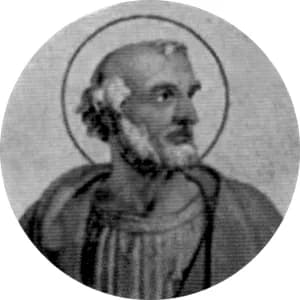
Saint Leo I
Elected in his absence, he wrote the Tome, faced Attila on the Mincio, and explained why every pope is Peter: the first pope called Great.
Pope no. 45440-461
Leo is the first pope whom the church calls Great, and the reasons are three: a letter, a meeting, and an idea. The letter is the Tome of 449, his statement of how Christ is one person in two natures, which the Council of Chalcedon acclaimed two years later with the cry that Peter had spoken through Leo, and which remains the standard of orthodox Christology for Catholics, Orthodox, and most Protestants alike. The meeting was with Attila on the banks of the Mincio in 452, from which the Hun turned back; whatever made him do it, Rome believed it was the pope. The idea is in the sermons Leo preached on the anniversary of his election: that Peter's authority does not die with Peter but lives in his see, so that whatever the bishop of Rome does rightly, Peter does through him. Every pope before Leo had claimed something like it. Leo said it in Latin sentences that no one could misread, and the papacy has been quoting them since.
He was also an administrator who hunted Manichaeans out of Rome, a jurist who obtained from the emperor a law making his decisions binding on the West, a preacher whose ninety-six surviving sermons are the first collection of papal preaching, and the bishop who met Gaiseric outside the gates in 455 and could not stop the sack but limited it. When he died in 461 he was buried in the porch of Saint Peter's, the first pope laid there since the apostle himself, which was, in his own terms, exactly where he belonged.
The deacon
Leo was a Tuscan by family, probably born in Rome around 400, and by the 430s he was the most important deacon in the city. John Cassian dedicated a treatise against Nestorius to him at his request; Cyril of Alexandria wrote to him about the ambitions of the bishop of Jerusalem; the chronicler Prosper says it was Leo who stiffened Sixtus III against reinstating the Pelagian Julian of Eclanum. In 440 the imperial court sent him to Gaul to reconcile two quarreling generals, and he was there when Sixtus died in August. The Romans elected him anyway, sent for him, and consecrated him on 29 September. He was, so far as the record shows, the first pope elected in his absence.
The heir of Peter
He set out his understanding of the office in the sermon he preached on the first anniversary, and repeated it every year after. Peter had confessed Christ at Caesarea Philippi and received the keys; Peter had come to Rome and died there; and Peter, "the rock," did not cease to govern the church when he died, because his authority passed to the see he had founded and to whoever occupied it.
Blessed Peter does not desert the helm of the church which he took up; the strength of that foundation is not lessened even by the weight of so great a temple built upon it. His dignity does not fail even in an unworthy heir.
The unworthy heir governed accordingly. In 443 he discovered that Manichaeans, refugees from Vandal Africa, were meeting secretly in Rome; he had them investigated by a court of bishops and senators, published their confessions, expelled the unrepentant, and obtained an imperial edict against the sect. He wrote to the bishops of Spain about the Priscillianists and to those of Sicily about the date of baptism. When Hilary of Arles, the ablest bishop in Gaul, deposed a colleague who appealed to Rome, Leo overturned the deposition, stripped Arles of its authority over the other Gallic churches, and in July 445 obtained from Valentinian III a law declaring that the bishop of Rome's rulings were binding on every bishop of the West, "since the primacy of the apostolic see is established by the merit of Saint Peter." It was the first time a Roman emperor had legislated the pope's supremacy, and Leo had drafted the argument.
The Tome
The crisis of the reign came from Constantinople. In 448 the archimandrite Eutyches, an old monk with friends at court, was condemned by his archbishop Flavian for teaching that Christ's humanity had been absorbed into his divinity, leaving one nature. Eutyches appealed to Rome; Flavian sent the acts; and on 13 June 449 Leo wrote Flavian the letter known as the Tome. It is not long. Christ is one person in whom two complete natures, divine and human, remain distinct without confusion, "each nature doing what is proper to it in communion with the other": the divine working miracles, the human suffering on the cross. It was a Latin answer, precise, legal, and confident, to a Greek argument that had run for a generation.
Theodosius II had already summoned a council to Ephesus for August, and put Dioscorus of Alexandria, Eutyches's patron, in charge of it. The council refused to read the Tome, rehabilitated Eutyches, deposed Flavian, who was beaten by the monks and died on the road into exile, and threatened Leo's legates, who fled. Leo called it a latrocinium, a den of robbers, and the name stuck. He appealed to the emperor, to the empress Pulcheria, and to the Western court; Theodosius refused to reopen the case. Then, in July 450, the emperor fell from his horse and died.
Chalcedon
His sister Pulcheria and her new husband Marcian summoned a council to Chalcedon, across the water from Constantinople, in October 451. More than five hundred bishops attended, Leo's legates presided in name, and the Tome was read. The acclamation is recorded in the acts: "This is the faith of the fathers. This is the faith of the apostles. Peter has spoken through Leo." Dioscorus was deposed, Eutyches's teaching condemned, and the council's definition of faith incorporated Leo's formula of two natures in one person. It was the greatest doctrinal victory a bishop of Rome had ever won.
The council's last act was the reason Leo took two years to confirm it. Canon 28 gave the see of Constantinople "equal privileges" with Rome and the second rank among the churches, on the ground that the city was the new capital of the empire. Leo's legates protested and walked out; Leo himself refused the canon in letters to Marcian, Pulcheria, and the patriarch Anatolius, insisting that the rank of a church came from its apostolic founder and not from the residence of emperors, and that Alexandria and Antioch, Peter's other sees, must keep their places. He accepted the doctrinal decisions in 453 and never accepted the canon. Nor did his successors, and the two principles, apostolic origin against imperial capital, define the quarrel between Rome and Constantinople for the next thousand years.
Attila and Gaiseric
In 452 Attila's Huns crossed the Alps, destroyed Aquileia, and moved through the cities of the Po valley toward Rome. The emperor Valentinian sent an embassy to meet him: Leo, the ex-consul Avienus, and the ex-prefect Trygetius. They met the Hun near Mantua, where the Mincio meets the Po, and Attila turned back.
Three years later there was no turning back. In March 455 Valentinian was murdered, his successor was torn apart by a mob in May, and Gaiseric's Vandal fleet arrived from Carthage. Leo met the king outside the walls and obtained a promise: no burning, no torture, no massacre. The Vandals then plundered Rome for fourteen days, stripping the temples and palaces, taking the empress Eudoxia and her daughters as hostages, and loading the ships with what Alaric had left. Leo spent the years after restoring the churches, replacing the silver the Vandals had melted, and ransoming captives, and he preached to a city that had begun to think of its bishop as its defender.
The first in the basilica
His last years were spent on the aftermath of Chalcedon in the East, where Alexandria rioted, murdered its Chalcedonian patriarch in 457, and installed a Monophysite; Leo wrote to the new emperor, also called Leo, a second and longer statement of the two natures that the East calls his second Tome. He set the rules of penance for Christians who had lapsed under the Vandals, wrote to Gaul and Spain, and preached on Christmas and Lent, on fasting and almsgiving, in a prose that Latin liturgy still borrows. He died on 10 November 461 and was buried in the entrance porch of Saint Peter's, where no pope had lain before. Sergius I moved him inside the basilica in 688; Benedict XIV named him a doctor of the church in 1754. The papacy he left had a theory of itself, an emperor's law behind it, a council's acclamation, and a city that had watched its bishop go out to meet the barbarians when the emperor would not.
Sources
- J. N. D. Kelly and Michael Walsh, The Oxford Dictionary of Popes (2010)
- Eamon Duffy, Saints and Sinners: A History of the Popes (2014)
- Leo the Great, Letters and Sermons (461) · link
- Susan Wessel, Leo the Great and the Spiritual Rebuilding of a Universal Rome (2008)
- Bronwen Neil, Leo the Great (2009)
- Raymond Davis (trans.), The Book of Pontiffs (Liber Pontificalis) (2000)
- Further reading: Wikipedia