The Iron Century903-1046
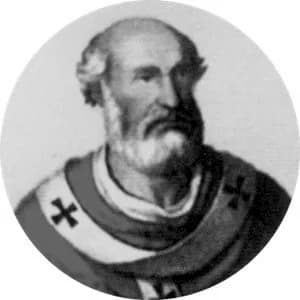
Lando
Six months in 913 and 914, one surviving grant, and the last new papal name for a thousand years.
Pope no. 121913-914
Lando came from the Sabina, the hill country north-east of Rome, the son of a count named Taino, and his name is Lombard, which suggests a family of the old Lombard nobility settled in the papal territory. He was elected in the summer of 913, in the last weeks of July or in August, with the consent of Theophylact and Theodora, and he died in the winter, in February or March 914, after a reign the Liber Pontificalis measures at six months and ten days. A single document survives: a grant to the cathedral of Forum Novum in his native Sabina, the church of Vescovio, made at the request of a member of his family. Nothing else is recorded of him, and nothing was expected.
His distinction is accidental. Every pope for a thousand years after him took a name that a predecessor had borne, John or Benedict or Gregory or Leo, until Albino Luciani in 1978 joined two of them to make John Paul; Lando was the last to be called by a name no pope had used, and the first Lando is also the only one. In the ordinary count he is pope one hundred and twenty-one, the fourth of the Iron Century, and the last of the interchangeable men Theophylact put in the Lateran before he reached outside Rome for one who was not interchangeable, the archbishop of Ravenna who became John X.
A full essay on this pope is in preparation. The facts and summary above are complete and sourced.
Sources
- J. N. D. Kelly and Michael Walsh, The Oxford Dictionary of Popes (2010)
- Eamon Duffy, Saints and Sinners: A History of the Popes (2014)
- Peter Llewellyn, Rome in the Dark Ages (1971)
- Further reading: Wikipedia