The Iron Century903-1046
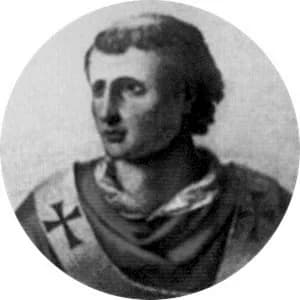
John X
He rode with the league that burned the Saracens out of the Garigliano, then watched Marozia's men kill his brother in the Lateran.
Pope no. 122914-928
John X is the pope who went to war and won, and the pope whose brother was murdered in front of him. He came to Rome in the spring of 914 as archbishop of Ravenna, chosen by the family that ran the city, Theophylact the master of the soldiers and his wife Theodora, and Liudprand of Cremona, writing forty years later, made him Theodora's lover and left him with a reputation he has never shaken. What he did in office is better attested. In the summer of 915 he assembled the alliance no one had managed in forty years, the Byzantine fleet, the Lombard princes of the south, the duke of Spoleto, and the king of Italy, and led the Roman contingent himself against the Saracen colony at the mouth of the Garigliano that had burned Monte Cassino and Farfa and raided the Campagna for a generation. After a siege of weeks the camp was destroyed, and the raids that had begun under John VIII ended. He crowned Berengar emperor for it, settled the schism at Constantinople over the emperor's fourth marriage, forbade the Slavonic liturgy in Dalmatia, and governed for thirteen more years with a firmness the century rarely saw.
Then he tried to be free of the family that had made him. He brought Hugh of Provence into Italy as king and set up his own brother Peter as a counterweight to Marozia, Theophylact's daughter, who now ruled Rome with her second husband. In May 928 her men broke into the Lateran, killed Peter before the pope's eyes, and put John in prison, where he died the next year, smothered with a pillow if Liudprand is to be believed. He was the ablest pope between Nicholas I and Sylvester II, and the Iron Century ate him.
Ravenna
He was born at Tossignano, in the hills above Imola, and began as a deacon of Bologna; he was elected bishop of Bologna and, before he could be consecrated, moved up to the archbishopric of Ravenna, the second see of Italy, about 905. Liudprand says the promotion was Theodora's doing, that she had met him on a visit to Rome and taken him as a lover, and that she later had him made pope so as to keep him near her. The story is the source of everything written about him since and rests on nothing but Liudprand's word.
He was consecrated at Rome in March 914, after Lando's death, and the move from Ravenna to Rome, a translation the canons forbade, passed without protest: Marinus I and Formosus had set the precedent, and Rome had other worries.
The Garigliano
The worry was the Saracen colony at the mouth of the Garigliano, planted about 881, which had burned Monte Cassino in 883 and Farfa in 898 and lived off the Campagna for a generation, because the Lombard princes of Capua, Naples, Gaeta, and Salerno found it useful to have their rivals' enemy on the coast. John changed the calculation. He got the Byzantine commander at Bari, Nicholas Picingli, to bring a fleet and troops; he got Alberic of Spoleto, the coming man of central Italy, and King Berengar; he got the princes, Landulf of Capua, John of Gaeta, and Gregory of Naples, by promising Gaeta the lands the Saracens held and by threatening the rest; and he came himself with the Roman militia. In June 915 the allies drove the Saracens into their stockade; the Byzantine ships closed the river mouth; in August the survivors broke out toward the hills and were hunted down in the woods, every one of them by the pope's own account. The colony that had held southern Latium for thirty-five years ceased to exist.
The pope himself was there with the Romans and, as he used to tell it afterward, twice charged the enemy at the head of his men and put them to flight.
In December 915 he crowned Berengar emperor in Saint Peter's, the reward for the campaign and the first imperial coronation since 901. It did Berengar little good; he was murdered at Verona in 924, and no one wore the title again until Otto.
The pope's business
The rest of the reign was the ordinary business of a competent pope in an incompetent age. He ended the schism in Constantinople over the fourth marriage of the emperor Leo VI, which Sergius III had approved and the patriarch Nicholas Mystikos had refused to forgive: his legates attended the synod of 920 that reunited the Byzantine church, condemned fourth marriages for the future, and let the emperor's stand. He held a synod at Split in 925 for the bishops of Dalmatia and Croatia and, in the spirit of Stephen V rather than John VIII, forbade the Slavonic liturgy that Methodius's disciples had brought there, allowing it only where no Latin priest could be found. He sent the pallium to Germany and to England, confirmed the privileges of Cluny, and wrote to Charles the Simple and to Henry the Fowler as an equal. Nothing in it is remarkable except that a pope of the 920s did it at all.
Marozia
The house of Theophylact had made him, and for a decade he ruled with it. Theophylact died about 920 and Theodora soon after, and their power passed to their daughter Marozia, married first to Alberic of Spoleto, the ally of the Garigliano, and, after Alberic was killed in a Roman rising about 925, to Guy, marquis of Tuscany. John looked for a counterweight. In 926 he invited Hugh of Provence into Italy, and Hugh became king at Pavia; John met him at Mantua and made a pact. In Rome he raised his own brother Peter, gave him Alberic's old duchy of Spoleto and a command in the city, and the Romans, which is to say Marozia, drove Peter out. Peter came back, Liudprand says, with a force of Magyars, and that was the end of any support the brothers had in Rome.
In May 928 Marozia and Guy of Tuscany brought armed men into the Lateran. Peter was cut down in front of the pope. John was seized, deposed, and shut in prison, and Marozia set up Leo VI in his place.
What he showed
John X was the one pope of the Iron Century who governed as if the office were more than the property of a Roman family, and the family destroyed him for it. The Garigliano freed Latium; the league that won it was the first time since Leo IV that a pope had brought the Italian powers together behind Rome, and the last until the eleventh century. His fall put the papacy in Marozia's hands for the next four years and in her son Alberic's for the twenty after that, and the lesson his successors drew was not to try. His reputation is Liudprand's revenge on the family, taken out on the one pope of theirs who deserved better.
Sources
- J. N. D. Kelly and Michael Walsh, The Oxford Dictionary of Popes (2010)
- Eamon Duffy, Saints and Sinners: A History of the Popes (2014)
- Paolo Squatriti (trans.), The Complete Works of Liudprand of Cremona (2007)
- Chris Wickham, Medieval Rome: Stability and Crisis of a City, 900-1150 (2015)
- Peter Llewellyn, Rome in the Dark Ages (1971)
- Philippe Levillain (ed.), The Papacy: An Encyclopedia (2002)
- Further reading: Wikipedia